Thursday, 25 April 2019

From The Floor Up: The Battle to Control HAIs


Floors, often overlooked in the past as a major factor of environmental contamination leading to increased HAI rates, are, in fact, a contributor to this very expensive and life-impacting problem. Studies have shown that floors harbor HAI pathogen organisms. These pathogens may not be neutralized by using mops that bind disinfectants or may be transported through unexpected means, including socks or laundered mops damaged by the laundering process and reducing their ability to effectively clean or disinfect the floor.

Download this whitepaper, which discusses:
  • Human and financial implications of HAIs.
  • Microfiber laundered mops retain residual pathogens.
  • Impact of laundry processes on microfiber’s structure and efficacy.
  • Moving to single-use mops.
Posted by Dr. Tim Sandle, Pharmaceutical Microbiology

Monday, 8 April 2019

Cleaning and Cleanrooms e-book


Pharmaceutical Manufacturing: Understanding Your Process Series  - Cleaning and Cleanrooms (e-book)

In the past 15 years, PDA/DHI has published more than 1,000 practical scientific and regulatory chapters, written by global subject matter experts, which have been designed to help pharmaceutical and biotech manufacturers stay abreast, streamline processes and comply with regulators.

We have now collected bestsellers and added materials that have not published before in electronic book form covering three vital topics:
  • Cleaning and Cleanrooms
  • Sterilization
  • Environmental Monitoring
These easily accessible, reasonably priced, informative collections offer background and hands-on applications that will help with a myriad of activities for manufacturers.

The Cleaning and Cleanrooms collection features a two-part history of cleaning and cleanrooms, classifications, supplies, sanitization and several other important topics. The book is edited by Tim Sandle and Jeanne Moldenhauer.

Contents:
  • The Development of Cleanrooms: An Historical Review Part 1: From Civil War to Safe Surgical Practice by Tim Sandle(New)
  • The Development of Cleanrooms: An Historical Review Part 2: The Path Towards International Harmonization by Tim Sandle (New)
  • Understanding Cleanroom Classifications by Jeanne Moldenhauer. (Chapter excerpted from Contamination Control in Healthcare Product Manufacturing, Volume 3, Chapter 12 published 2014.)
  • Cleanroom Supplies by Jeanne Moldenhauer. (Chapter excerpted from Environmental Monitoring: A Comprehensive Handbook, Volume 1, Chapter 11 published 2005.)
  • Practical Aspects of Cleaning, Sanitizing and Disinfecting Rooms and Surfaces by Jeanne Moldenhauer. (Chapter excerpted from Environmental Monitoring: A Comprehensive Handbook, Volume 1, Chapter 12 published 2005.)
  • Cleaning Validation: Process Life Cycle Approach by Paul Lopolito and Elizabeth Rivera. (Chapter excerpted from Contamination Control in Healthcare Product Manufacturing, Volume 3, Chapter 10 published 2014.)

Available to download. Prior to purchase please view the download instructions and Terms of Usage.
Format: PDF (1 file 1.72 MB)

Posted by Dr. Tim Sandle, Pharmaceutical Microbiology

Thursday, 4 April 2019

Monocyte activation test - live webinar


Monocyte activation test: a powerful tool to assess pyrogenic risk in the pharmaceutical process
Microbial risk in the pharmaceutical manufacturing process cannot be limited to viable microorganisms. Even if drug substances are manufactured in clean conditions and final drug products are sterilized, some subcellular microbial components may remain at the end of the manufacturing process.

To minimize the risk of subcellular microbial components remaining in the final drug product, a risk assessment approach of the whole manufacturing process can be applied, as described by Friedrich von Wintzingerode1.

These subcellular contaminants often include Pathogen Associated Molecular Pattern (the so-called PAMPs) that can trigger the human immune system leading to inflammatory response and constitute a pyrogenic risk for patients. That’s why ensuring the absence of such components in the final drug product before batch release is key for product quality and patient safety.

In any case, testing for endotoxins in the final drug product before batch release is currently a minimum requirement from regulations. To reinforce the risk management approach, a new recommendation was added to the European Pharmacopeia chapter 5.1.10 « Guidelines for using the test for bacterial endotoxins » requiring users to carefully evaluate the risk for pyrogens (i.e. endotoxins and non-endotoxin pyrogens) before implementing the Bacterial Endotoxin Test (BET) as the sole pyrogenicity test. This is because the BET is designed to detect endotoxins only, leaving room for missing non-endotoxin pyrogens that could be responsible for fever reaction in patients.

The EP chapter 5.1.10 also indicates that “To rule out the presence of non-endotoxin pyrogens in substances or products, the use of the monocyte-activation test (2.6.30) is recommended at release or during development of the production process”. Indeed, the Monocyte Activation Test (MAT), mimics the human immune reaction to pyrogens by detecting all kinds of pyrogens that trigger the monocytes through the toll-like receptor (TLR) pathway, making it a powerful tool to assess pyrogenic risk in pharmaceutical process.

The PyroMAT™ System, our ready-to-use MAT kit using a monocytic cell line, has demonstrated the ability to detect a wide range of pyrogens. Each batch of PyroMAT™ cells is qualified for the expression of all the surface TLRs to ensure the detection of both endotoxins and non-endotoxin pyrogens. With our PyroMAT™ System, we provide a new solution for sensitive, robust, and easy-to-perform pyrogen testing.

New tools to assess the risk of microbial impurities in the pharmaceutical manufacturing process

Join the live webinar on April 9th, 2019, 10:00 am CEST


For more information about the PyroMAT™ System, click here

1 von Wintzingerode F. Biologics Production: Impact of Bioburden Contaminations of Non-Sterile Process Intermediates on Patient Safety and Product Quality.  Am Pharm Rev. 2017 Apr;20(3)

Posted by Dr. Tim Sandle, Pharmaceutical Microbiology

Wednesday, 3 April 2019

Suicide system in tuberculosis bacteria might hold key to treatment


Tuberculosis (TB) is one of the top ten causes of death worldwide. In 2017, 10 million people around the world fell ill with TB and 1.3 million died. The genome of the bacterium that causes TB holds a special toxin-antitoxin system with spectacular action: once the toxin is activated, all bacterial cells die, stopping the disease. An international research team co-led by the Wilmanns group at EMBL in Hamburg investigated this promising feature for therapeutic targets. They now share the first high-resolution details of the system in Molecular Cell.

Mycobacterium tuberculosis is the bacterium that causes TB in humans. Its genome holds 80 so-called toxin-antitoxin (TA) systems: sets of closely linked genes that encode both a toxic protein and an antitoxin: a toxin-neutralising antidote.

When the bacteria are growing normally, toxin activity is blocked by the antitoxin’s presence. But under stress conditions such as lack of nutrients, dedicated enzymes rapidly degrade the antitoxin molecules. This activates the toxin proteins in the cell and slows down the growth of the bacteria, allowing them to survive the stressful environment.

Novel NAD+-degrading toxin triggers cell death of tuberculosis-causing bacteria. The illustration shows sections of Mycobacterium tuberculosis bacteria. The Pac-Man symbolizes the toxin, which in the absence of its antitoxin counterpart, ‘eats up’ the NAD+, causing the cell to die. In the bacterium in the back, the Pac-Man’s mouth is blocked by the antitoxin, preventing the degradation of NAD+ and allowing the cell to grow normally. Illustration by Beata Edyta Mierzwa.

One particular TA system has a more drastic effect: in the absence of the antitoxin, the toxin kills the bacteria. As this system holds potential for therapeutic targets, researchers from EMBL Hamburg, the IPBS at the CNRS/Université de Toulouse, and the Crick Institute in London joined forces to study this TA system in more detail.

“Our goal was to see the TA system’s structure, so we could try to understand and even manipulate it. It was as if we were working blindly before”, says Annabel Parret, EMBL staff scientist in the Wilmanns group, who led the project.
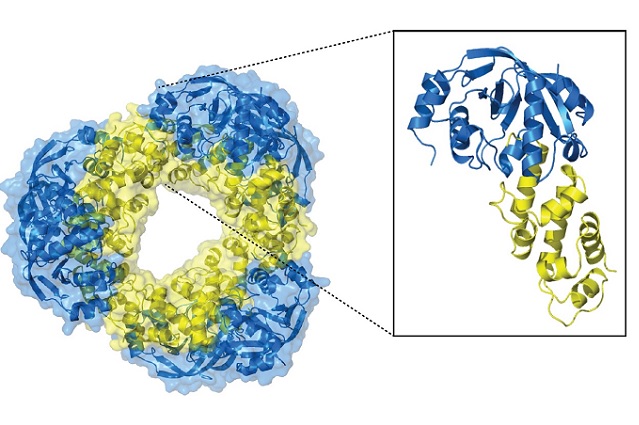
The high-resolution structure of the toxin-antitoxin system. CREDIT: EMBL Hamburg

The high-resolution structure – solved within eight months by first author Diana Freire – revealed a large and compact system with a double-doughnut shape. “It looks like a diamond, and it is very stable,” says EMBL group leader Matthias Wilmanns. The structure resembles the toxins of cholera and diphtheria: diseases that caused epidemics with hundreds of thousands of people dying even within the past 100 years.

Knowledge of the structure gave important guidance for further studying the system’s biochemistry – a challenging part of the project. By using an interdisciplinary approach, the team were able to discover the details of the TA system’s mode of action. When the toxin dissociates from its antidote, it becomes activated and starts to degrade essential cellular metabolites called NAD+ molecules. This “suicide” activity ultimately leads to the death of all bacterial cells. Why the bacteria have such a suicide system is puzzling, but there is no doubt it has the potential to be exploited as a drug target.

“Our collaborators in Toulouse were already able to extend the lifetime of mice infected with TB by activating the toxin in a controlled way,” says Parret. “If we find molecules that can disrupt the TA system – and thus trigger cell death – in TB patients, that would be the perfect drug.”

The team will now screen thousands of small molecules to see if they have this capability. However, the structure of the TA system is so stable that it will be a big challenge to find an entry point where they can go in to break it. Wilmanns: “But if we succeed, this could be a new approach for treating TB and other infectious diseases.”

This project was a collaboration between researchers from the Wilmanns group at EMBL Hamburg and the Neyrolles group at the IPBS, CNRS/Université de Toulouse, and involved the Carvalho group at the Francis Crick Institute in London. The research team has started a partnership to work towards a potential TB drug, through EMBL’s technology transfer arm EMBLEM.

Source article:

Freire, D.M., Gutierrez, C., et al. An NAD+ phosphorylase toxin triggers Mycobacterium tuberculosis cell death. Molecular Cell, published online 18 February 2019.

Posted by Dr. Tim Sandle, Pharmaceutical Microbiology

Monday, 1 April 2019

New edition - Industrial Pharmaceutical Microbiology: Standards & Controls


A new edition of “Industrial Pharmaceutical Microbiology: Standards & Controls”. The 5th edition  - fully revised and expanded - is edited by Dr. Tim Sandle. This publication covers the entire spectrum of industrial and pharmaceutical microbiology, as applicable to those working in pharmaceuticals, medical devices, biotech, and healthcare, as well as academia.

The book is available from the publisher - please see the Euromed websitehttp://euromedcommunications.com/index.php?option=com_virtuemart&view=productdetails&virtuemart_product_id=2&virtuemart_category_id=1&Itemid=201 

The reference is:

Sandle, T. (2019) Industrial Pharmaceutical Microbiology: Standards & Controls, 5th edition, Euromed Communications, Passfield, UK 

What readers are saying:

"This book is not simply about the science of microbiology for it takes the science into to the industrial setting and offers invaluable advice on how to apply it to the manufacture of pharmaceutical and healthcare products, and for keeping such products within microbial control. A further strength with the book is its topicality, in having the most recent regulations and standards featured. The book features 25 chapters covering environmental monitoring, water systems, vaccines, safety, biological indicators and microbiology laboratory management. Picking the stand-out chapters is difficult, because there are so many good ones. … In summary this book is essential for every pharmaceutical laboratory: scientific, topical and practical."

Posted by Dr. Tim Sandle, Pharmaceutical Microbiology

Monday, 25 March 2019

Biocontamination control for pharmaceuticals and healthcare


A new book has been published – “Biocontamination Control for Pharmaceuticals and Healthcare” by written Tim Sandle.

The book outlines a biocontamination strategy that tracks bio-burden control and reduction at each transition in classified areas of a facility. This key part of controlling risk escalation can lead to the contamination of medicinal products, hence necessary tracking precautions are essential. Regulatory authorities have challenged pharmaceutical companies, healthcare providers, and those in manufacturing practice to adopt a holistic approach to contamination control. New technologies are needed to introduce barriers between personnel and the environment, and to provide a rapid and more accurate assessment of risk. This book offers guidance on building a complete biocontamination strategy.

Key features of the book are:

Providing the information necessary for a facility to build a complete biocontamination strategy.
Helping facilities understand the main biocontamination risks to medicinal products.
Assisting the reader in navigating regulatory requirements.
Providing insight into developing an environmental monitoring program.
Covering the types of rapid microbiological monitoring methods now available, as well as current legislation.

Table of Contents

1 Introduction
2. Sources of microbial contamination and risk profiling
3. GMP, regulations and standards
4. Biocontamination control
5. Introduction to cleanrooms and environmental monitoring
6. Viable monitoring methods
7. Selection of culture media
8. Non-viable monitoring
9. Rapid microbiological methods
10. Designing an environmental monitoring programme
11. Special Types of Environmental Monitoring
12. Cleanrooms and microflora
13. Assessment of pharmaceutical water systems
14. Data handling and trend analysis
15. Bioburden and endotoxin assessment of pharmaceutical processing
16. Risk assessment and investigation for environmental monitoring
17. Assessing and removing contamination risks from the process
18. The human factor
19. Biocontamination deviation management

374 pages


Reference:

Sandle, T. (2019) Biocontamination Control for Pharmaceuticals and Healthcare, Academic Press, London, UK

Posted by Dr. Tim Sandle, Pharmaceutical Microbiology

Monday, 18 March 2019

Kenneth G. Chapman Award


Tim Sandle, Ph.D., Head of Microbiology and Sterility Assurance, Bio Products Laboratory Limited, has been awarded the prestigious Kenneth G. Chapman Award by the Institute of Validation Technology.

Ken Chapman served with Pfizer Inc for 43 years in various Production, R&D, and QC roles, retiring as Director of Corporate Quality Assurance Audit in 1994. He served on the Editorial Review Board of Pharmaceutical Technology and, in October 1988, was presented the Pharm. Tech. Publisher's Award at E. Rutherford, NJ. He also served on the Editorial Advisory Board of the Journal of Validation Technology and was honored with the Life Time Achievement Award by the Institute of Validation Technology (IVT).

See IVT - http://www.ivtnetwork.com/article/announcing-our-2018-award-winners


Posted by Dr. Tim Sandle, Pharmaceutical Microbiology

Wednesday, 13 March 2019

Review of Standards for Disinfectants; and associated guidance


The Australian TGA have initiated a review into hard surface disinfectants. The TGA
invites comments on their proposed update. It is intended that the updated TGO will incorporate all relevant regulatory requirements, comprising:


Updated sections of TGO 54 that clarify existing requirements,
The labelling requirements of the former TGO 37(which has now sunset), and,
Standards and requirements contained within the guidelines for the evaluation of disinfectants.

See: https://www.tga.gov.au/consultation/consultation-review-therapeutic-goods-order-54-standards-disinfectants-and-associated-guidance

Posted by Dr. Tim Sandle, Pharmaceutical Microbiology

Tuesday, 12 March 2019

Pharmig News #74


A new edition of Pharmig News has been published. In the latest issue:
  • The hidden problems with relaundering microfibre mops by Karen Rossington
  • Endotoxin hot topics and issues by Ruth Noé and Julie Roberts
  • Validation of contact plates for environmental monitoring by Merck KGaA, Darmstadt, Germany
  • Pharmig Membership Survey by Tim Sandle
  • Latest regulatory news
  • And more!
Copies have been sent out. If you would like to see a copy, please email: info@pharmig.org.uk

Key reference:

Sandle, T. (2019) Pharmig membership survey, Pharmig News, Issue 74, pp9-12


Posted by Dr. Tim Sandle, Pharmaceutical Microbiology

Thursday, 28 February 2019

Rare Disease Day


Rare Disease Day is an observance held on the last day of February to raise awareness for rare diseases and improve access to treatment and medical representation for individuals with rare diseases and their families.

Every year, thousands of events are organised around the world during the month of February to mark the occasion of Rare Disease Day. Patient organisations, healthcare professionals, researchers, policymakers and other members of the rare disease community organise Rare Disease Day events.


Building awareness of rare diseases is so important because 1 in 20 people will live with a rare disease at some point in their life. Despite this, there is no cure for the majority of rare diseases and many go undiagnosed. Rare Disease Day improves knowledge amongst the general public of rare diseases while encouraging researchers and decision makers to address the needs of those living with rare diseases.


Posted by Dr. Tim Sandle, Pharmaceutical Microbiology

Thursday, 21 February 2019

Pharmacovigilance Inspection Metrics April 2017 to March 2018

The MHRA GPvP inspectorate published their latest inspection metrics for the period from April 2017 to March 2018.

Pharmacovigilance (PV) is defined as the science and activities relating to the detection, assessment, understanding and prevention of adverse effects or any other drug-related problem. WHO established its Programme for International Drug Monitoring in response to the thalidomide disaster detected in 1961. Together with the WHO Collaborating Centre for International Drug Monitoring, Uppsala, WHO promotes PV at the country level. At the end of 2010, 134 countries were part of the WHO PV Programme. The aims of PV are to enhance patient care and patient safety in relation to the use of medicines; and to support public health programmes by providing reliable, balanced information for the effective assessment of the risk-benefit profile of medicines.

See: https://mhrainspectorate.blog.gov.uk/2018/12/04/pharmacovigilance-inspection-metrics-april-2017-to-march-2018/

Posted by Dr. Tim Sandle, Pharmaceutical Microbiology

Sunday, 3 February 2019

Effective training for cleanroom cleaning


A new article of interest.

Controlled environments are required for the manufacture of pharmaceutical products. Once a grade is assigned a number of physical and microbiological parameters need to be met. Controlled environments also need to be regularly cleaned and disinfected. While cleaning processes are defined, issues still arise with cleaning and disinfection effectiveness when undertaken by operators. E-learning provides an alternative approach to training. This article reviews the importance of cleaning and disinfection in cleanrooms; the importance of training; and the role that e-learning can play, centring on a new e-learning package from Pharmig.

The reference is:

Sandle, T. (2018) Effective training for keeping cleanrooms clean, Cleanroom Technology, 26 (11): 36-37

For details, contact Tim Sandle

Posted by Dr. Tim Sandle, Pharmaceutical Microbiology

Friday, 1 February 2019

Agrichemicals and antibiotics in combination increase antibiotic resistance evolution


"Agrichemicals and antibiotics in combination increase antibiotic resistance evolution". An interesting article was published in PeerJ during 2018, and it's worth revisiting.

The abstract reads:

"Antibiotic resistance in our pathogens is medicine’s climate change: caused by human activity, and resulting in more extreme outcomes. Resistance emerges in microbial populations when antibiotics act on phenotypic variance within the population. This can arise from either genotypic diversity (resulting from a mutation or horizontal gene transfer), or from differences in gene expression due to environmental variation, referred to as adaptive resistance. Adaptive changes can increase fitness allowing bacteria to survive at higher concentrations of antibiotics.

"They can also decrease fitness, potentially leading to selection for antibiotic resistance at lower concentrations. There are opportunities for other environmental stressors to promote antibiotic resistance in ways that are hard to predict using conventional assays. Exploiting our previous observation that commonly used herbicides can increase or decrease the minimum inhibitory concentration (MIC) of different antibiotics, we provide the first comprehensive test of the hypothesis that the rate of antibiotic resistance evolution under specified conditions can increase, regardless of whether a herbicide increases or decreases the antibiotic MIC. 

"Short term evolution experiments were used for various herbicide and antibiotic combinations. We found conditions where acquired resistance arises more frequently regardless of whether the exogenous non-antibiotic agent increased or decreased antibiotic effectiveness. This is attributed to the effect of the herbicide on either MIC or the minimum selective concentration (MSC) of a paired antibiotic. The MSC is the lowest concentration of antibiotic at which the fitness of individuals varies because of the antibiotic, and is lower than MIC. 
Our results suggest that additional environmental factors influencing competition between bacteria could enhance the ability of antibiotics to select antibiotic resistance. Our work demonstrates that bacteria may acquire antibiotic resistance in the environment at rates substantially faster than predicted from laboratory conditions."

See: PeerJ

Posted by Dr. Tim Sandle, Pharmaceutical Microbiology

Thursday, 31 January 2019

Special magnetic coating used to kill bacteria, an antibiotic alternative


The problems and limitations of antibiotics and antimicrobial substances have received a great deal of attention in the press. The main concern is bacterial resistance. As an alternative, a science group have developed a special coating which can destroy bacteria on contact.

A research team based at the Nanyang Technological University (NTU), Singapore, have developed a special coating which has a magnetic-like feature. The magnetic nature is used to attract bacteria and then kills them. The application could lead to an antibiotic 'alternative'.

According to an NTU press release, the special sponge-like coating is made from Dimethyldecylammonium Chitosan methacrylate. The coating is a type of polymer which holds a positive charge. The charge acts like a type of magnet which generates a force. The force draws bacteria, which possess a negative charge on their cell walls, towards the surface. When the bacterium comes in contact with the coating, the cell walls are 'sucked' into the nanopores, causing the cell to rupture, thus killing the bacterium.

The Alpha Galileo Foundation notes that the coating has been tested against bacteria like Pseudomonas aeruginosa, which can cause infections in the upper respiratory tract, gastrointestinal tract and the urinary tract; and Staphylococcus aureus, which can cause infections ranging from skin boils or abscesses to deadly diseases such as pneumonia and meningitis.

The research was led by Professor Mary Chan, Acting Chair of NTU's School of Chemical and Biomedical Engineering. The research findings were published in the journal Nature Materials.

Chan is quoted by the Meridian Institute as saying, in relation to the research:

"The coating can also be applied on biomedical objects, such as catheters and implants to prevent bacterial infections, which is a serious cause of concern as many bacteria are now developing resistance to antibiotics - currently our main source of treatment for infections. By developing novel materials which uses physical interaction to kill bacteria cells, we envisage this can be an alternative form of treatment for bacterial infections in the near future."

A key advantage with the coating is that it is harmless to human cells.

The application is thus far being used by two companies: a contact lens manufacturer and a company specializing in animal care products. The next wave of developments is likely to be with implants and surgical instruments.

Posted by Dr. Tim Sandle, Pharmaceutical Microbiology

Friday, 25 January 2019

Examining the reliability of manual plate colony counts in environmental monitoring


An interesting essay has been published on-line about colony counting by R. Hutchinson:

Plate counts of colony forming units (CFUs) are the gold standard of microbial enumeration and therefore essential to environmental monitoring in the pharmaceutical industry. There are strict regulations regarding bioburden at each stage of pharma production, from raw materials to finished products, but we often fail to question whether current methods are rigorous enough to fulfil these requirements.

The article can be accessed here.

Posted by Dr. Tim Sandle, Pharmaceutical Microbiology

Special offers