Showing posts with label Contamination control. Show all posts

Tuesday, 10 February 2026

Floor Surface Contamination in Controlled Environments: A Change in Mindset


Objectives

  • Evaluation argument for contamination control at the floor level
  • Including the floor level in a holistic view of the contamination control process

The Story

Studies in the late 1960’s – 1970’s demonstrated that redistribution of bacteria into the air from the floor accounted for up to 15% of all airborne bacteria (Hambraeus et al. 1978) and disinfection alone is short lived given the rapid rate of recontamination on vast surface such as the floor (Ayliffe, 1967).

Current evidence surrounding floors as a key surface discusses how it may act as a reservoir in the chain of infection both in sensitive environments and potentially in other facilities as well.

The 2000’s started to paint a clearer picture of how floor surfaces acted as vectors of re-dispersion for microbes (Gupta, 2007). The evidence consistently points in the direction of floors playing a role in pathogen dissemination, especially dust particles (Prout, 2013). Backing earlier research linking the risk of human shedding issues (Hambraeus, 1978) & their pathogenic risk if airborne (Wei, 2016).

While there is limited research being developed on floor level controls outside of the healthcare setting, it is generalized as a relegated entity within a contamination control practice versus other surfaces.

The Science

The largest surface area in each room is seeing the least control across a variety of industries ….

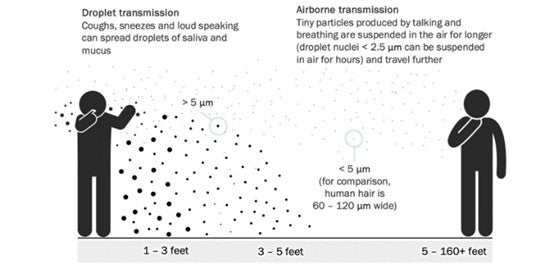
Touch level and air surface cleanliness alone are not sufficient practices based on the criticality of the areas they are positioned in. At best, one of the most basic requirements in controlled environments, shoe covers,  can themselves be a new vector of concern due to cross contamination between zones.

Define Vectors – A vector is a path for contamination to travel with minimum disruption or control through wheels, shoes and the surfaces as a whole
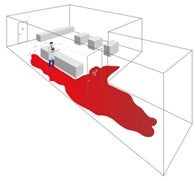
More people + more capacity + more activity = more particles + more risk = more control

Most end users spend 80% of budget/time/effort on 20% of a problem when a reversal can yield more sustainable, long-term gains.

Floor level control reduces substantial risk prior to controlled entry in a far more sustainable way.
The ‘Sense’

Cases explored and the Onion.

The five second rule might apply in your kitchen, but it does not apply in sensitive manufacturing.

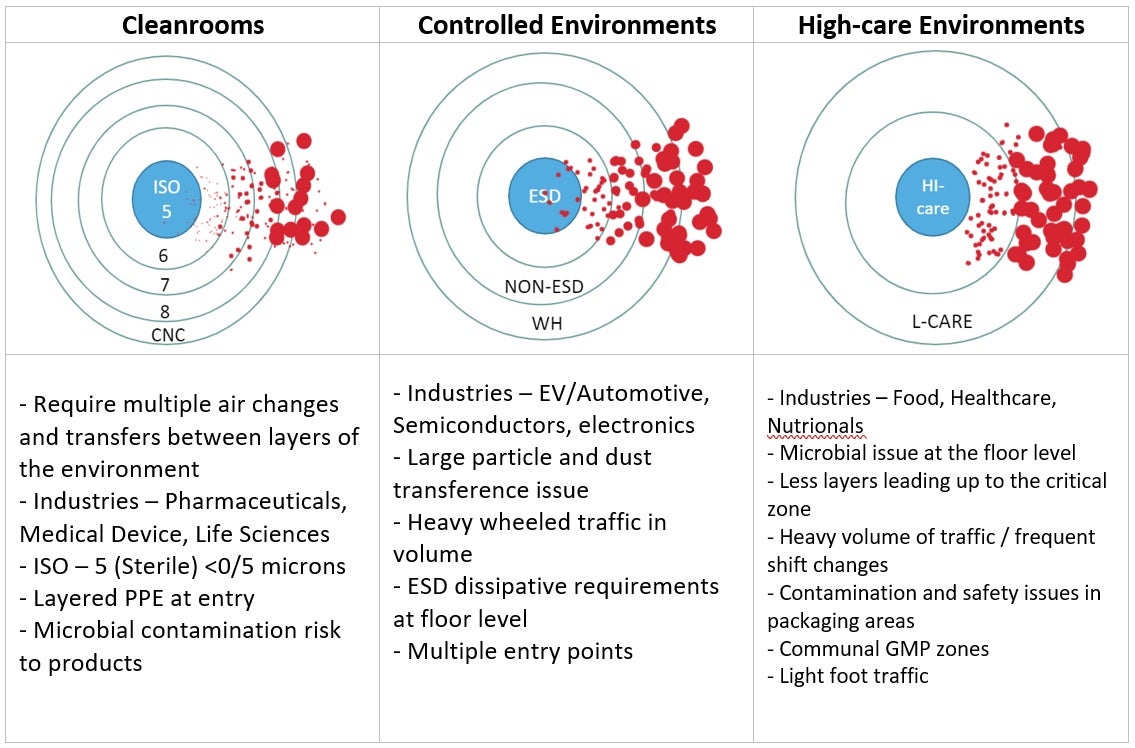
The following diagrams represent a concept presented by Dr. Tim Sandle, he calls it the onion concept. This concept illustrates the most critical area, the one you want to keep free of contamination at the center of the diagram. This could be a cleanroom, controlled environments, and/or high-care settings. The critical center area is protected by the outer layers (or other areas) that surround it. Certain measures are put in place in these outer layers to prevent contamination from entering the critical area, this can include hand washing, gowning and contamination control flooring. As personnel move through each layer, it becomes cleaner and cleaner until they reach the critical area in the center. Depending on the criticality of the site, it will determine how many layers or areas there are to move through before reaching the center.

You can see below a diagram of how particles at floor level may travel through each layer, the red particles show the general risk and most contamination comes from the outer layers inwards. The larger particles tend to be prevented earlier on and less particles are transferred as you move through the layers.

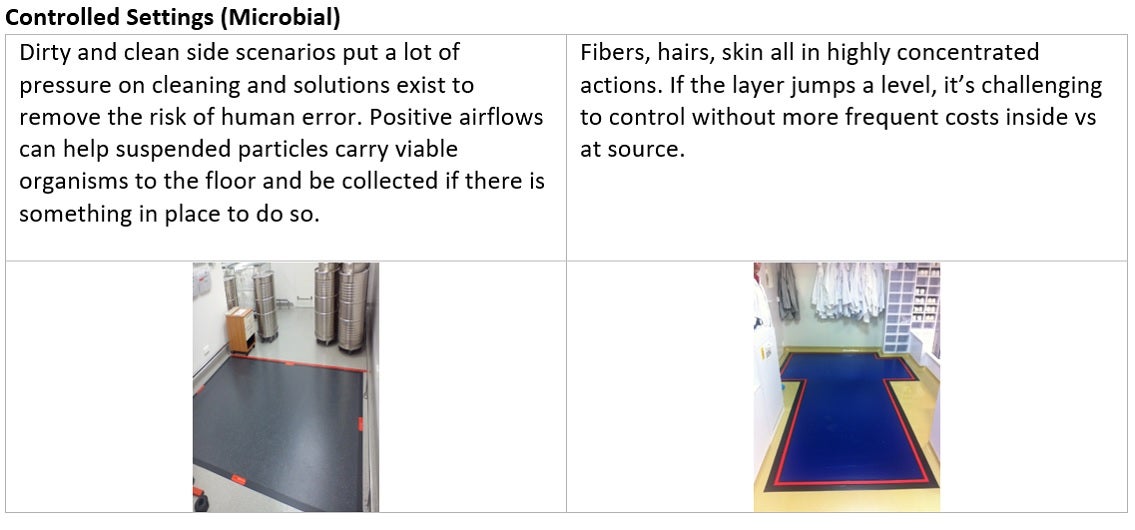
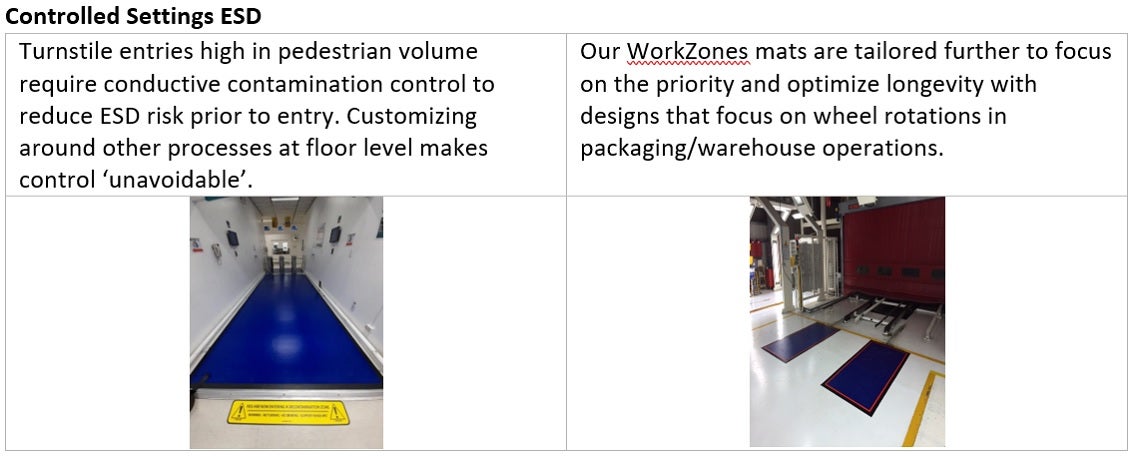
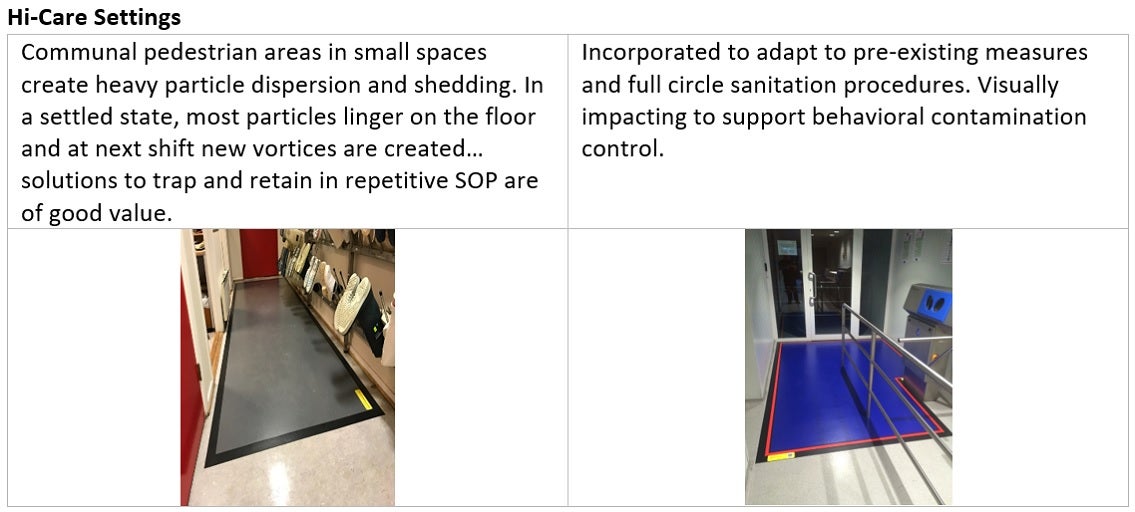
A selection of settings where this is applicable…
The Suggestion

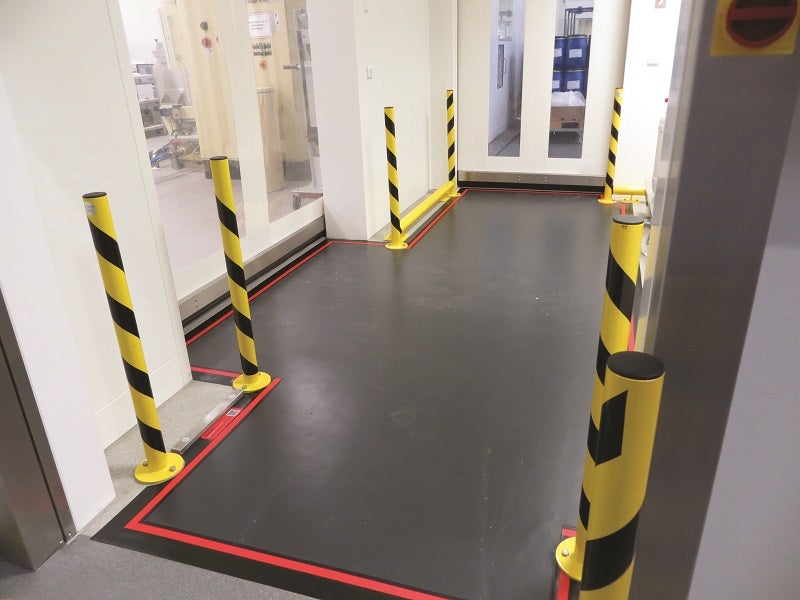
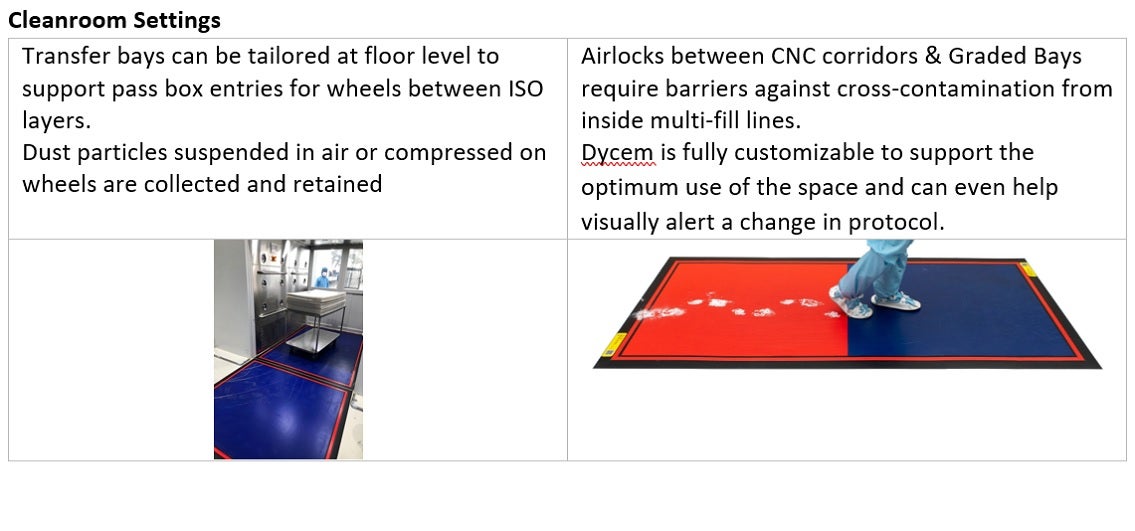
Dycem Contamination control flooring alternatives.
The Statement

Moving forward, what influence will floors have on contamination control?

As Floors are a surface of high transmission, the contamination risk merits wider, more comprehensive research to value its part in a contamination control strategy (CCS). Part of this research considers the floor as a priority ‘vector surface’ to allow it to share equal weight in developing a CCS. If floors are treated for particulate control at the source of contamination, they can offer an exhaustive list of benefits for critical and controlled settings. Practitioners of CCS should approach the topic with a more holistic view to develop a CCS as part of their day-to-day, good manufacturing practices (GMP).

Dycem has vastly improved cross-contamination reduction through its ability to be unavoidable, simple, and a long-term, effective solution.

Posted by Dr. Tim Sandle, Pharmaceutical Microbiology Resources (http://www.pharmamicroresources.com/)

Thursday, 28 August 2025

The 3Ws of Microbial Data Trends in Environmental Monitoring


Contamination has been one of the consistent central reasons for drug product recalls. Pharmaceutical manufacturers witnessed an average of 330 recalls every year in the past decade. Deviations from Current Good Manufacturing Practices (cGMP) standards also have emerged as a significant driver of product recalls in recent times. According to a report by USFDA, in 2025, there were 123 product recall events caused by cGMP deviations. In 2022 and 2023, drug recalls surged as contamination issues and sterility concerns continued to dominate the list.

Drug recall types, 2022


Monitoring microbial data trends enables smarter, faster decisions that directly impact product quality and patient safety. These trends strengthen quality systems, support regulatory compliance, and help ensure medicines are safe, sterile, and reliable.

This article focuses on how quality control teams in microbial laboratories can prevent contamination, achieve process control and be audit-ready always. It underpins the need for digital EM systems through the 3Ws framework – What, Why, and How of microbial trends.

WHAT are Microbial Trends

Sterile spaces in pharma manufacturing facilities including cleanrooms, production zones, and isolators aren’t always sterile, despite the tightest controls. Microbes find their way through people, air, or surfaces. This is where microbial trends come in. By collecting and analyzing microbial data and their patterns, teams maintain control, detect emerging risks, and protect product quality.

The traditional methods of data collection often resulted in fragmented spreadsheets, causing delays in insights. However, with automated environmental monitoring (EM) systems, real time dashboards, and predictive analytics, microbial trends lead to more actionable insights than ever. Here’s how digital technology is reshaping EM systems.

®     Automated sampling with LIMS integration

®     Real-time alerts and data visualization trends

®     Algorithms to detect shifts in microbial profiles

Metrics speak volumes. Digital environmental monitoring software track metrics that drive valuable insights into microbial data. These insights can bring clarity and speed to decisions. A few metrics that are being tracked are –

·         Microbial loads and diversity across specified zones/rooms

·         Excursion frequency by site and operator

·         Pathogen detection rate

·         Historical trend analysis

As a result of these advanced metrics, enterprises are now moving from static compliance control to dynamic trend monitoring. This helps teams to flag risks instantly and supports analytics-driven decision-making.

WHY are Microbial Trends Important?

Monitoring microbial trends is more than just a regulatory checkbox. Understanding microbial behavior and patterns is fundamental to maintaining a state of control in QC labs. It ensures your cleanroom environment is contaminant-free. Here’s why the ‘Why’ matters.

Identify the root cause. Automated systems quickly correlate microbial spikes with potential issues, if it is due to room usage or operator activities.

Early warnings. Trends help identify deviations at an early stage, preventing major contamination events.

Ensure regulatory compliance. Regulatory agencies like the EMA and FDA emphasize trend review and data integrity during inspections. Trends imply that enterprises use proactive compliance measures.

Variable action limits. Ongoing, real-time analysis allows users to adjust thresholds based on real-world scenarios rather than static baselines.

Drive continuous improvement. With real time ingestion of microbial data, teams can map the effectiveness of sanitization, HVAC upgrades, gowning procedures, and other relevant processes.

An EMA reports 79% of warning letters issued to companies globally cite data integrity as a major concern. With digital EM software, teams can monitor and track environmental data holistically.

How to leverage microbial data trends

You have the trends, now what? Microbial trends are useful only when they help teams make smarter decisions.

This is where modern digital environmental monitoring tools such as CaliberEMpro come in. With digital EM software it becomes easy to capture, visualize, and act on trends. It automates everything from spotting anomalies early to adjusting alert limits proactively, giving you confidence that your cleanroom is under control.

With CaliberEMpro your labs can:

·         Capture data in real-time

·         Instantly visualize both – safe zones and red flags

·         Adjust alert limits with factual data

·         Get automated alerts for deviations

This keeps your cleanrooms in control, always. No more spreadsheet chaos or scrambling before inspections. Environmental monitoring trends can be your first line of defense. By turning insights into clear, actionable steps, you can be confident that your SOPs are doing their job well.

Beyond Monitoring: Adding Intelligence with CalGenie

While CaliberEMpro manages real-time microbial data, CalGenie adds an extra layer of intelligence. As Caliber’s Generative AI engine, CalGenie extracts, interprets, and contextualizes microbial and quality data from complex documents. This allows teams to:

·         Automate document analysis for faster reporting

·         Connect microbial trends with broader quality insights

·         Support predictive analytics for future contamination risks

Together, CaliberEMpro + CalGenie help pharmaceutical enterprises move from data collection to intelligence-driven action, enhancing both compliance and operational excellence.

Act Smarter, Act Faster

Let’s face it – collecting microbial data is the easy part. Knowing what to do with it is a real game changer. Today’s digital EM systems don’t just track data; they unlock valuable insights in real time, empowering you by answering the most important question: Are we in control?

Trends tell you a visual story in the form of slow climbs, spikes, and shifts over time. Let this story guide your action plan of building a culture of control, quality, and continuous improvement. It is not just about passing audits; it is about making quality decisions faster.

Caliber Technologies connects the dots between microbial trend monitoring, AI intelligence, and pharma quality.


Posted by Dr. Tim Sandle, Pharmaceutical Microbiology Resources (http://www.pharmamicroresources.com/)

Monday, 28 April 2025

Addressing human factors in decontamination


Ensuring that surgical processing departments are well-run is of great importance, as these departments are responsible for decontaminating reusable surgical equipment and for delivering it, as required, to operating theatres. Decontamination involves several  processes, occurring within dedicated facilities, including cleaning, disinfection and sterilisation, which ensures reusable surgical instruments are safe for further use on patients.

The operation requires maintaining a well-ordered facility, ensuring it is clean and decontamination practices can be consistently reproduced. While most units have well-written procedures, human errors will happen and these can sometimes lead, in the most serious cases, to the transference of contamination and patient infection (healthcare-associated infections). While human failure is normal and predictable, it can be identified and managed. Hence, errors can be reduced by reviewing how surgical processing departments are managed and how personnel operate, in particular, by reducing the level of variability. An approach that can deliver success in this area is the ‘human factors method’.

This article looks at three areas where human factors approaches can assist with improving performance through lowering variability and, hence, reducing contamination rates. These are: Development of procedures; Training; Space and ergonomics. Prior to this, the article introduces the subject of human factors and looks at sources of variability within surgical processing departments.

Sandle, T. (2023) Addressing human factors in decontamination, Clinical Services Journal, 22 (7): 39-43
 

To read, see: Human Factors

Posted by Dr. Tim Sandle, Pharmaceutical Microbiology Resources (http://www.pharmamicroresources.com/)

Monday, 14 October 2024

Improving aseptic transfer: Advantages of the IsoBag® solution

IsoBag® (Merck image, with permission)
 

The revision to EU GMP Annex 1, in August 2022, updated the requirement for Grade A environments used during sterile manufacturing. This was the change in acceptance criteria to ‘no growth’ (from the previous value of 1 CFU). This change not only paves the way for alternative microbiological methods it signalled the shift in regulatory thinking towards the detection of any contamination within the aseptic core being atypical and problematic.


One of the dilemmas faced by microbiologists, on the recovery of contamination at Grade A, is whether the contamination derived from the aseptic operation or from the activity of transfer in to or out of the aseptic environment. If adventitious contamination cannot be verified, the recovery could lead to a batch rejection.


A potential microbial contamination transfer risk exists with both RABS (restricted access barrier systems) and isolators, given the need to introduce materials from outside of the protective barrier. While isolators afford greater protection by virtue of providing a complete barrier and an environment that can be subjected to an automated decontamination cycle, the transfer issue still presents a concern.


This article looks at the problem of transferring materials to the aseptic core from lower controlled environments and describes a solution from Merck that significantly improves the environmental monitoring workflow through the use of the IsoBag® solution.


Contamination transfer risks


One of the primary routes by which contamination enters the aseptic core is through material transfer, either on items or from personnel interacting with the transferred materials. Sources of microbial contamination represent hazards, and the level of risk depends on the likelihood of contamination being transferred from the source to the critical area. Assessing such risks and designing them out of the process is a central part of the Contamination Control Strategy (CCS). The CCS is an important component of Annex 1 (1).


This requires hazard analysis and risk assessment, as represented by figure 1:


Figure 1: Hazard analysis and assessment


With figure 1, risk is lowered through controls. Examples of controls required to reduce the risks include (1, 2):


  • Assessment of the vendor’s suitability to supply consumables.
  • Elimination of items unsuitable for introduction into a cleanroom. Need for incoming consumables to be multi-wrapped (minimum of three layers in addition to outer packaging).
  • Need for sporicidal disinfection when transferring between areas of different cleanliness levels (such as cleanrooms of different grades). 
  • The avoidance of items that generate fibres.
  • Using airlocks and transfer hatches between cleanrooms of different grades.
  • Having appropriate pressure differentials.
  • Ensuring airlocks and transfer hatches areas are interlocked and that alarms must be in place. Controlling the time of transfer so that disinfected items are subjected to the required contact time. 
  • For transfer between Grade C and B, in ensuring that items are flushed with HEPA filtered air.
  • Adopting ‘no touch’ solutions to transfer items into Grade A.


With each step, contamination can be transferred and any weakness leading to contamination being detected in the aseptic core may have arisen from the external packaging if decontamination steps were inadequate or if the execution of controls was performed inadequately. The CCS helps to drive consideration of the ‘bigger picture’.


Importantly the emphasis should always be on control. Achieving control is achieved by identifying hazards and then risk assessing these hazards for their severity (should they occur) and their likelihood of occurring. One aspect of control is with design improvement and the IsoBag® solution is an example of such an improvement.


IsoBag® solution


The IsoBag® solution enables bagged culture media and exposed plates to be successfully transferred into and out of an isolator, eliminating the opportunity for cross-contamination from personnel or from the environment. This transfer mechanism means that, post-incubation, any contamination detected is reflective of the Grade A environment.


Improving asepsis


Where plates are pre-loaded into an isolator ahead of decontamination, the process of packs of plates reaching the isolator requires a layer to be removed as the plates move from a preparation area to the surrounding isolator environment (typically EU GMP Grade C) and then into the isolator. This means that the plates presented to the isolator are only single wrapped. Whilst steps will be taken by personnel to minimise contamination transfer from the unwrapping process as plates transition through the facility this is a manual disinfection process. A reliance on manual disinfection will occasionally lead to contamination, given the intricacies of manual disinfection. Furthermore, no isolator decontamination process is 100% efficient, especially when endospore forming bacteria are transferred into the isolator and where there is the potential for occluded surfaces.


Reducing transfer risks


The design of the IsoBag® solution avoids contamination transfer through the use of an alpha-beta port system (where the alpha port is the port designed within the isolator and the beta port is the basis of the IsoBag®). The alpha-beta design is based on DPTE® technology.


DPTE® is a rapid transfer port technology, developed by Getinge, enabling a reliable and leak tight transfer. With the process, the alpha part and the beta part are connected by a manual 60° rotation which detaches the doors from their supports and then joins them together. Once these are secured, the doors can now be opened without breaking sterility or containment and items transferred.


Tightness is secured by the lip seals of the new assembly.


Enhancing sterility


IsoBag® are prepared prepacked with environmental monitoring plates. These plates, together with the complete bag assembly, are sterilised by radiation, which is a proven method of decontamination and effective against endospore forming bacteria.. The irradiation process is also demonstrated not to affect the growth promoting properties of the culture medium (with or without the addition of a disinfectant neutraliser).


Improving decontamination cycle robustness


Another advantage of the IsoBag® is that microbiological culture media, in the form of contact and settle plates, does not need to be placed inside the isolator to be decontaminated before use. When decontamination cycles are run, using methods like vapour hydrogen peroxide, the decontamination process is achieved through surface contact. The more items that are pre-loaded into the isolator then the greater the chance of insufficient surface contact occurring, or with surface occlusion arising, and hence inadequate decontamination.


The IsoBag® eliminates this step, thereby reducing the number of items that need to be placed inside the isolator in advance of decontamination and enabling culture media to be used as required.


Flexibility and space


The IsoBag® concept also increases the available space within the isolator and avoids it from becoming cluttered with too many plates. The IsoBag® enables only those plates that are required to be seamlessly transferred in. This creates more working space.


The concept also adds flexibility in that should more environmental monitoring media than was originally anticipated be needed, then additional plates can be rapidly transferred. The alpha-beta port system enables up to 10 connections and disconnections


in the process and keeping those plates available for use at any time. Unlike traditional methods, where single-bagged plates are decontaminated and stored in the isolator, limiting space and often interrupting workflow, with our IsoBag®, plates are mounted to the isolator’s port and used directly since they are already gamma-irradiated (ready-to-use). In addition to safety and efficiency, the process also frees up time and saves money.


Meeting data integrity expectations


The culture media transported via the IsoBag® is presented in a format that reduces cross-contamination through the plates having lockable lids, thereby ensuring that post-sampling contamination is unlikely. Data integrity is further enhanced through the use of 2D-datamatrix codes, which ensure sample traceability.


Summary


The activity of transferring materials in and out of the aseptic core requires planning and a highly-developed workflow. This is necessary to avoid introducing microorganisms into the critical area and for protecting samples from adventitious contamination after sampling. Failure to do so is problematic – either putting sterile products at risk or creating false negatives. The IsoBag® concept provides a mechanism to avoid these problems – both for transfer in and out of the isolator.


References


1. Sandle, T. (2023) Biocontamination Control for Pharmaceuticals and Healthcare, 2nd edition, Academic Press, London, UK

2. Strategy/Program: From Global Development to Site Implementation, American Pharmaceutical Review, at: https://www.americanpharmaceuticalreview.com/Featured-Articles/564173-Establishing-a-Contamination-Control-Strategy-Program-From-Global-Development-to-Site-Implementation/


Posted by Dr. Tim Sandle, Pharmaceutical Microbiology Resources (http://www.pharmamicroresources.com/)

Special offers