Wednesday, 18 February 2026

Why Treating Mental Health and Addiction Separately Often Fails

A man expressing sadness with his head in his hands. Image by Tellmeimok, CC BY-SA 4.0
 

For decades, mental health treatment and addiction treatment were placed in separate boxes. Someone struggling with depression was sent one way. Someone struggling with substance use was sent to another. Too often, people were told they had to “fix” one problem before addressing the other.

This approach may seem logical on the surface—but in real life, it often fails.

Mental health and addiction are deeply connected. When they are treated separately, important pieces of the recovery puzzle are missed. Understanding why this happens is key to creating care that truly supports long-term healing.


Mental Health and Addiction Are Closely Linked

Mental health conditions and substance use disorders frequently occur together. This is known as co-occurring disorders or dual diagnosis.

Acc/ording to the Substance Abuse and Mental Health Services Administration (SAMHSA), nearly 9.2 million adults in the U.S. experience both a mental health disorder and a substance use disorder in the same year.

Common mental health conditions that co-occur with addiction include:

     Anxiety disorders

     Depression

     Post-traumatic stress disorder (PTSD)

     Bipolar disorder

     Chronic stress and emotional dysregulation

These conditions do not exist in isolation. They influence each other every day.


Why Separation Became the Norm

Historically, addiction was viewed as a behavioral or moral problem, while mental health conditions were treated as medical or psychological issues. This led to two separate systems of care, often with different providers, philosophies, and treatment goals.

In practice, this separation creates gaps:

     Mental health providers may feel unprepared to address substance use

     Addiction programs may avoid deeper emotional or trauma work

     Clients are left bouncing between systems without coordinated care

The result is fragmented treatment that does not reflect how people actually experience their struggles.


How Treating Addiction Alone Can Fall Short

When addiction is treated without addressing mental health, people may achieve short-term sobriety—but struggle to maintain it.

Unaddressed mental health symptoms can include:

     Persistent anxiety or panic

     Depression or hopelessness

     Trauma triggers

     Emotional overwhelm

According to the National Institute on Drug Abuse (NIDA), untreated mental health conditions significantly increase the risk of relapse.

If substances were being used to cope with emotional pain, removing them without offering healthier coping tools leaves a major gap. Stress returns. Symptoms intensify. Old patterns resurface.


How Treating Mental Health Alone Can Also Miss the Mark

Treating mental health while ignoring substance use can be just as limiting.

Substances can:

     Interfere with therapy progress

     Disrupt sleep and mood regulation

     Increase impulsivity and emotional instability

     Reduce the effectiveness of medications

According to NIDA, ongoing substance use can worsen mental health symptoms and reduce the success of mental health treatment.

This can leave people feeling stuck—doing “all the right things” in therapy while still struggling to function.


The Role of Trauma in Both Conditions

Trauma often sits at the center of both mental health challenges and addiction.

According to the Centers for Disease Control and Prevention (CDC), individuals with high exposure to adverse childhood experiences (ACEs) are significantly more likely to experience both mental health disorders and substance use problems later in life.

When trauma is not addressed:

     Anxiety remains heightened

     Emotional regulation is difficult

     Substance use may continue as a coping response

Treating trauma separately—or not at all—leaves the root cause untouched.


Why Sequential Treatment Often Fails

Many people are told they must:

  1. Get sober first
  2. Then address mental health

Or:

  1. Stabilize mental health first
  2. Then address substance use

This sequential approach can be unrealistic and discouraging.

Mental health symptoms can make early sobriety harder. Substance use can make mental health stabilization difficult. Waiting to treat one condition delays healing for both.

According to SAMHSA, integrated treatment—where both conditions are addressed together—leads to better engagement, improved stability, and lower relapse rates.


What Integrated Treatment Does Differently

Integrated treatment recognizes that people are whole, complex human beings—not a list of diagnoses.

Instead of separating care, integrated programs:

     Treat mental health and addiction at the same time

     Use coordinated treatment planning

     Address trauma, stress, and coping skills together

     Provide consistent messaging and support

This approach reduces confusion and creates a clearer path forward.


Evidence-Based Therapies That Support Integrated Care

Integrated treatment uses therapies that work across conditions.

Cognitive Behavioral Therapy (CBT)

CBT helps people understand how thoughts, emotions, and behaviors interact—supporting both mental health stability and recovery.

Trauma-Informed Therapy

Trauma-informed care prioritizes safety, trust, and choice, reducing shame and supporting emotional regulation.

EMDR (Eye Movement Desensitization and Reprocessing)

EMDR helps process unresolved trauma that contributes to both mental health symptoms and substance use.

Group Therapy

When facilitated with emotional safety, group therapy reduces isolation and builds connection.

According to the American Psychological Association, integrated, trauma-focused therapies lead to better outcomes for people with co-occurring conditions.


The Impact on Long-Term Recovery

When mental health and addiction are treated together:

     Emotional triggers become manageable

     Coping skills strengthen

     Relapse risk decreases

     Quality of life improves

A study published in the Journal of Substance Abuse Treatment found that individuals receiving integrated care had higher treatment retention rates and better long-term recovery outcomes than those receiving separate or sequential treatment.

Recovery becomes more than abstinence—it becomes stability.


What This Means for Families

Families often feel confused when their loved one improves briefly, then struggles again. This cycle can happen when treatment addresses only part of the problem.

Integrated care helps families:

     Understand the full picture

     Reduce blame and frustration

     Learn how mental health and addiction interact

     Support lasting recovery

According to SAMHSA, family involvement improves outcomes when treatment addresses both conditions together.


A More Compassionate Model of Care

Treating mental health and addiction separately often fails because it does not reflect real human experience.

People do not struggle in neat categories. They struggle with pain, stress, trauma, and survival—all at once.

Integrated, trauma-informed care offers a more compassionate and effective path forward.


Healing Is Possible with the Right Approach

When mental health and addiction are treated together, recovery becomes more sustainable and humane.

People are no longer asked to choose which part of themselves deserves care. They are supported as whole individuals—with dignity, understanding, and hope.


Sources

  1. Substance Abuse and Mental Health Services Administration (SAMHSA) – Co-Occurring Disorders
    https://www.samhsa.gov/mental-health/substance-use-co-occurring-disorders
  2. National Institute on Drug Abuse (NIDA) – Comorbidity
    https://nida.nih.gov/research-topics/comorbidity
  3. Centers for Disease Control and Prevention (CDC) – Adverse Childhood Experiences (ACEs)
    https://www.cdc.gov/violenceprevention/aces
  4. American Psychological Association (APA) – Integrated Treatment
    https://www.apa.org/monitor/2016/06/co-occurring
  5. Journal of Substance Abuse Treatment – Integrated Care Outcomes
    https://www.sciencedirect.com/science/article/pii/S0740547216303906


Pharmaceutical Microbiology Resources (http://www.pharmamicroresources.com/)

Friday, 13 February 2026

23rd Annual Global Biopharma Manufacturing and Trends Analysis 2026


 The power of biotechnology...

BioPlan conducts biopharma industry's most comprehensive global benchmarking analysis, and we need your participation. For over 20 years we've analyzed advances in bioprocessing, new technologies and emerging trends, and your feedback is crucial!

For all completed and qualified surveys, you'll receive a copy of the summary results, along with an honorarium. Click here continue.

Tim Sandle's microbiology website:- microbiology now!

 Posted by Dr. Tim Sandle, Pharmaceutical Microbiology Resources (http://www.pharmamicroresources.com/)

Tuesday, 10 February 2026

Floor Surface Contamination in Controlled Environments: A Change in Mindset


Objectives

  • Evaluation argument for contamination control at the floor level
  • Including the floor level in a holistic view of the contamination control process

The Story

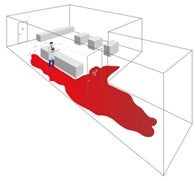
Studies in the late 1960’s – 1970’s demonstrated that redistribution of bacteria into the air from the floor accounted for up to 15% of all airborne bacteria (Hambraeus et al. 1978) and disinfection alone is short lived given the rapid rate of recontamination on vast surface such as the floor (Ayliffe, 1967).

Current evidence surrounding floors as a key surface discusses how it may act as a reservoir in the chain of infection both in sensitive environments and potentially in other facilities as well.

The 2000’s started to paint a clearer picture of how floor surfaces acted as vectors of re-dispersion for microbes (Gupta, 2007). The evidence consistently points in the direction of floors playing a role in pathogen dissemination, especially dust particles (Prout, 2013). Backing earlier research linking the risk of human shedding issues (Hambraeus, 1978) & their pathogenic risk if airborne (Wei, 2016).

While there is limited research being developed on floor level controls outside of the healthcare setting, it is generalized as a relegated entity within a contamination control practice versus other surfaces.

The Science

The largest surface area in each room is seeing the least control across a variety of industries ….

Touch level and air surface cleanliness alone are not sufficient practices based on the criticality of the areas they are positioned in. At best, one of the most basic requirements in controlled environments, shoe covers,  can themselves be a new vector of concern due to cross contamination between zones.

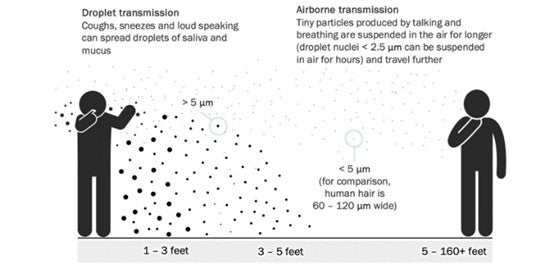
Define Vectors – A vector is a path for contamination to travel with minimum disruption or control through wheels, shoes and the surfaces as a whole

More people + more capacity + more activity = more particles + more risk = more control

Most end users spend 80% of budget/time/effort on 20% of a problem when a reversal can yield more sustainable, long-term gains.

Floor level control reduces substantial risk prior to controlled entry in a far more sustainable way.

The ‘Sense’

Cases explored and the Onion.

The five second rule might apply in your kitchen, but it does not apply in sensitive manufacturing.

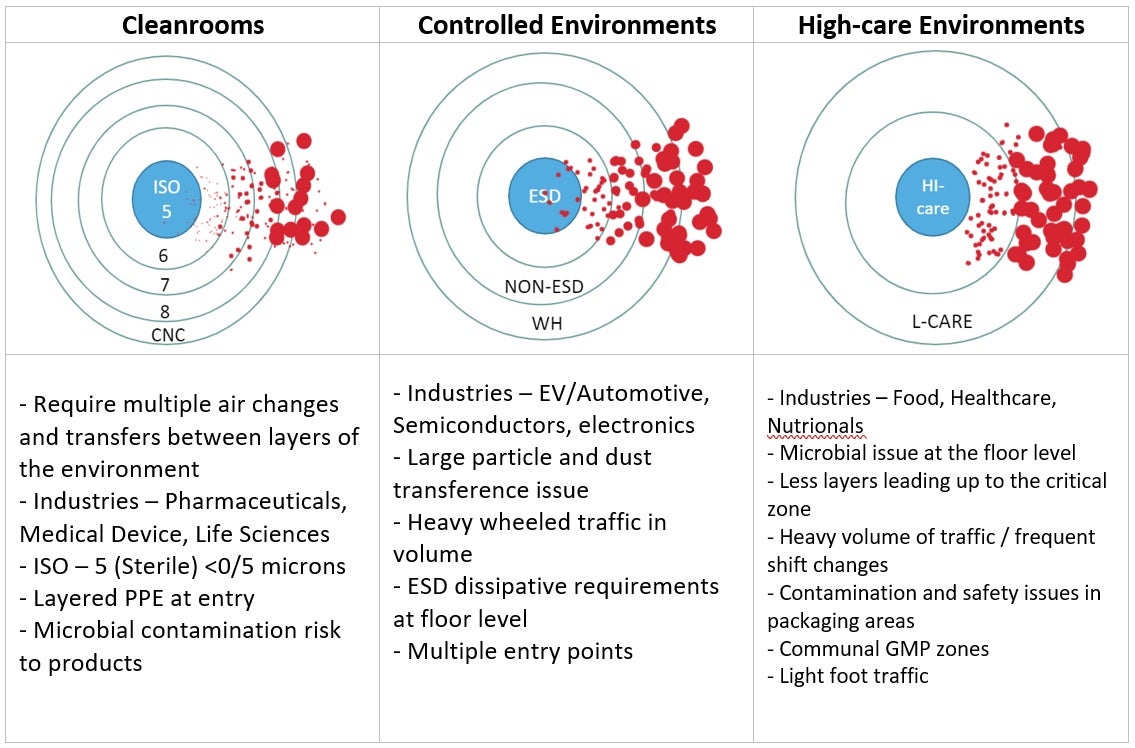
The following diagrams represent a concept presented by Dr. Tim Sandle, he calls it the onion concept. This concept illustrates the most critical area, the one you want to keep free of contamination at the center of the diagram. This could be a cleanroom, controlled environments, and/or high-care settings. The critical center area is protected by the outer layers (or other areas) that surround it. Certain measures are put in place in these outer layers to prevent contamination from entering the critical area, this can include hand washing, gowning and contamination control flooring. As personnel move through each layer, it becomes cleaner and cleaner until they reach the critical area in the center. Depending on the criticality of the site, it will determine how many layers or areas there are to move through before reaching the center.

You can see below a diagram of how particles at floor level may travel through each layer, the red particles show the general risk and most contamination comes from the outer layers inwards. The larger particles tend to be prevented earlier on and less particles are transferred as you move through the layers.

A selection of settings where this is applicable…

The Suggestion

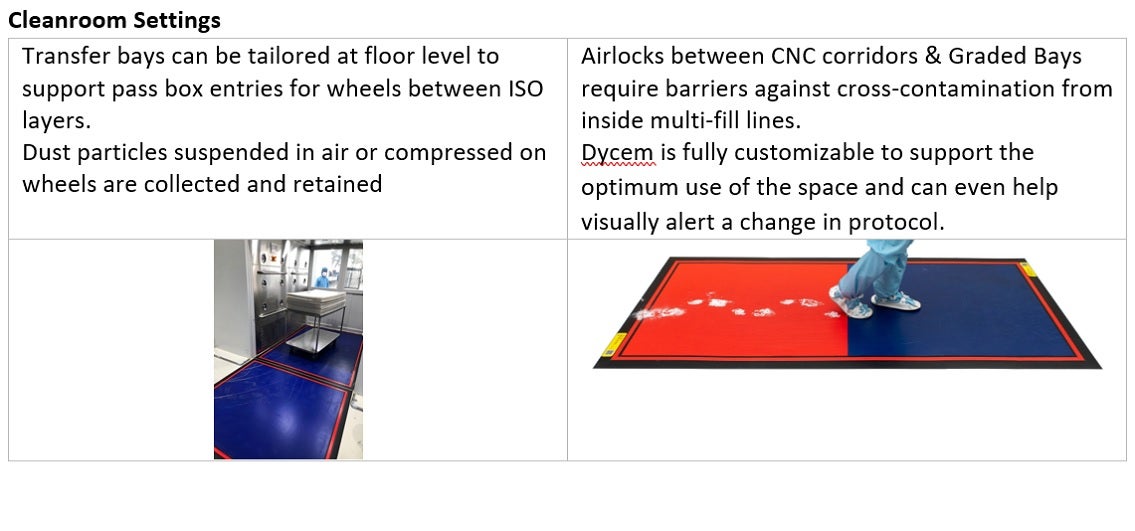
Dycem Contamination control flooring alternatives.

The Statement

Moving forward, what influence will floors have on contamination control?

As Floors are a surface of high transmission, the contamination risk merits wider, more comprehensive research to value its part in a contamination control strategy (CCS). Part of this research considers the floor as a priority ‘vector surface’ to allow it to share equal weight in developing a CCS. If floors are treated for particulate control at the source of contamination, they can offer an exhaustive list of benefits for critical and controlled settings. Practitioners of CCS should approach the topic with a more holistic view to develop a CCS as part of their day-to-day, good manufacturing practices (GMP).

Dycem has vastly improved cross-contamination reduction through its ability to be unavoidable, simple, and a long-term, effective solution.

Posted by Dr. Tim Sandle, Pharmaceutical Microbiology Resources (http://www.pharmamicroresources.com/)
Sunday, 8 February 2026

Cleaning and disinfection techniques


Posted by Dr. Tim Sandle, Pharmaceutical Microbiology Resources (http://www.pharmamicroresources.com/)
Monday, 2 February 2026

An appreciation


Pharmaceutical Microbiology Resources (http://www.pharmamicroresources.com/)
Best Merck webinars - 2025


Missed an interesting webinar recently? Check out this list of high quality webinars from Merck:

New EN ISO 7218 on General Requirements and Guidance for Microbiological Examinations in the Food Chain_Session 1

Updated standards for laboratory quality and compliance.
Watch Now >>

Ecomapping® – A Practical Approach to Implement Sustainability in Your Lab

Practical methods to optimize resource use and sustainability.
Watch Now >>

Green Chemistry as the Foundation of Sustainability and the Circular Economy

Principles and applications of eco-friendly chemical synthesis.
Watch Now >>

The Art of Filtration 3.0

Advances in filtration technology for sample preparation.
Watch Now >>

Revolutionizing Therapeutic Development with Patient-Centric Models

Innovative cell culture models transforming drug development.
Watch Now >>

Expert Perspectives: Balancing Time and Contamination Risks in Sterility Testing

Strategies for contamination risk management and timelines.
Watch Now >>

The Power of Foundations – The Basics of IHC

Essential immunohistochemistry fundamentals.
Watch Now >>

Getting Equipped for the Future with the New MAS-100 Sirius® Microbial Air Sampler

Latest equipment innovations for pharmaceutical production.
Watch Now >>


Posted by Dr. Tim Sandle, Pharmaceutical Microbiology Resources (http://www.pharmamicroresources.com/)
Friday, 30 January 2026

Driving pharmaceutical quality with digital standards


 Image designed by Tim Sandle

Pharmaceutical manufacturing is digitizing and with this transformation comes the need for quality standards that can integrate with digital ecosystems. 

USP is updating Chapter 11 to address developments with digital standards. 

USP is evolving how qualitystandards are integrated into digital environments, bringing science-based rigor, regulatory confidence, and seamless connectivity to pharmaceutical workflows. By embedding digital reference standards and compendial methods into connected systems, USP helps manufacturers advance digitization without compromising quality. 

USP is helping organizations navigate transformation complexity and support integration of digital quality systems with trusted standards, validated methods, and collaborative innovation.

What are digital standards? 


USP digital standards are machine-readable digitally structured versions of established USP reference standards and test methods. Digital standards bring the same science-based rigor and confidence as USP’s physical standards but can be seamlessly integrated into digital workflows. 

Digital standards allow for: 

  • Risk Mitigation & Traceability: Electronic capture of every step, version-controlled reference materials, and simplified reviews.
  • Faster Tech Transfer: Standardized digital workflows and “digital twin” reference materials reduce variability across labs.
  • Efficiency & Innovation: Automation and advanced analytics free resources and drive continuous improvement
  • Why use USP digital standards?
  • Regulatory uncertainty is the top barrier to adoption of digital standards. USP Standards are recognized and accepted by leading regulatory bodies and have been helping to ensure consistent quality across manufacturing sites, R&D facilities, and QC laboratories for more than 200 years. 


By evolving how these trusted standards integrate into digital environments, we can bridge science, regulation, and technology to ensure quality and increase confidence at every step. 


USP digital standards include: 

  • dDS: USP digital Documentary Standards (dDS) are machine-readable in a validated, digital-first format, designed to power advanced laboratory workflows and enable the adoption of new technologies into quality systems.
  • dRS: USP digital Reference Standards (dRS) are digital data demonstrated to have the appropriate qualities to support their intended use as references for comparison in compendial tests.


Posted by Dr. Tim Sandle, Pharmaceutical Microbiology Resources (http://www.pharmamicroresources.com/)
Thursday, 29 January 2026

Towards a 7-hour sterility test?


The 14-day turnaround time of current compendial sterility testing is plainly insufficient for a wide range of crucial, life-saving drugs and therapies, including an increasing number of novel cell and gene therapies which are incompatible with membrane filtration. As even slight contamination is unacceptable for parenteral treatments, this necessitates sterility tests that are not only faster than traditional methods, but as sensitive and accurate.

With an ever-increasing demand for faster sterility testing solutions, Alpha Laboratories is pleased to introduce the new RiboNAT™ rapid sterility test by FUJIFILM Wako. This test has been designed with rapid results in mind. It uses the Nucleic Acid Amplification (NAT) method, targeting ribosomal RNA (rRNA) and using RT-rPCR to deliver accurate results in just 7 hours. This test method boasts numerous benefits compared to other sterility tests – ribosomal RNA is present in higher relative quantities in microorganisms than genomic DNA, offering higher sensitivity (9 CFU/mL) while still detecting a broad range of bacteria and fungi. RiboNAT also significantly reduces false positives from dead microorganisms and residual DNA by inactivating and degrading DNA using nucleic acid inactivator and DNase.

The ability of RiboNAT to reliably and accurately detect a wide assortment of microbes in less than a day makes it an invaluable tool for validating and delivering drugs and therapies with short shelf lives, without having to administer at risk. This also seamlessly adds a crucial control point for sterility quality control into your workflow, with a simple and easy-to-learn testing process.

For further details, see: RiboNAT


Posted by Dr. Tim Sandle, Pharmaceutical Microbiology Resources (http://www.pharmamicroresources.com/)
Monday, 26 January 2026

Europe's ATMP sphere - new insights

Image: Adoptive T-cell therapy. By Simon Caulton - Own work, CC BY-SA 3.0, https://commons.wikimedia.org/w/index.php?curid=29559885

During ESMO back in October 2025, more than twenty leading experts from Europe's ATMP sphere came together to discuss the key challenges the region faces developing and manufacturing novel therapeutics.

As a result of the discussion, a whitepaper written in collaboration between the Oslo Cancer Cluster and the Bayer CGT center has been published.


Advanced Therapy Medicinal Products (ATMPs) - insights by Tim Sandle

The guide can be accessed here


Posted by Dr. Tim Sandle, Pharmaceutical Microbiology Resources (http://www.pharmamicroresources.com/)
Special offers