Microbiome research has advanced considerably since the first results from the U.S. National Institutes of Health led Human Microbiome Project were released. One area of interest is the connection between our microorganisms and anxiety symptoms. At first glance, the connection between the array of different microorganisms that are found within the human gut and feelings such as anxiety is not an obvious one. However, there is a growing level of evidence that variations within microbial communities are influential upon metabolic processes.
Human microbiome

The human microbiome refers to the totality of microorganisms and their genetic interactions within a given niche. Our understanding of the microbiome has advanced following a study of 300 men and women, who volunteered to take part in an international study. The advancement in understanding relating to developments with the methods used to characterize the microorganisms (including metagenomics) and the in-depth nature of the study, relating to the sampling of many body parts over a prolonged period of time, and drawing upon of the subjects from different geographical locales.
With the specific effects in relation to the human gut, then the understanding by scientists of the gut-brain axis has increased during the past ten years, suggesting a bidirectional nature between the gut and brain microbiome interactions. This includes a connection relating to the pathophysiology and pathogenesis of irritable bowel syndrome (IBS), as an example.

In another research field, there is growing evidence of psychiatric and neurologic disorders like autism spectrum disorders, affective disorders, Parkinson's disease, and multiple sclerosis, being connected to the human gut microbiome.
The reason for this is that, with most people, the gut microbiota assist with the healthy functioning of the immune system. Furthermore, organisms assist with the metabolism by contributing inflammatory mediators, vitamins, and nutrients. Moreover, microbiologists have demonstrated that the intestinal microbiota can modulate communication between the intestinal tract and human brain via the nervous, immune, and endocrine systems.
However, when the intestinal microbial balance is altered, then changes occur and these can be manifest in terms of physical, and potentially mental, symptoms. One area being investigated in relation to a mental system is anxiety.
Anxiety
Anxiety is an emotion characterized by an inner turmoil. It is often accompanied by nervous behaviour, somatic complaints, and rumination. The condition includes subjectively unpleasant feelings of dread over anticipated events. When experienced regularly the individual may suffer from an anxiety disorder. The global incidence of anxiety disorder is estimated to be between 3-25 percent. Typical treatment for anxiety is usually psychopharmacological therapies and psychotherapy.
New research
With the new research, scientists have attempted to see if anxiety symptoms can be improved by regulation of intestinal microorganisms. By assessing some 3,334 published articles the researchers focus on 21 major studies. Across these studies,1,503 participants included "patients with IBS (10 studies), healthy controls (six studies) and other patients with chronic diseases such as chronic fatigue syndrome (CFS), rheumatoid arthritis (RA), obesity, fibromyalgia, and type 2 diabetes mellitus."
Of the 21 studies, 14 had chosen probiotics as interventions to regulate intestinal microbiota (IRIFs), and seven chose non-probiotic ways, such as adjusting daily diets. Those studies that utilized "interventions regulating intestinal flora" consisting of probiotics with Lactobacillus alone or a mixture of Lactobacillus, Streptococcus, and Bifidobacterium, showed some positive results. Overall, 11 of the 21 studies suggested a positive effect on anxiety symptoms by regulating intestinal microbiota, meaning that more than half (52 percent) of the studies showed this approach to be effective.
To draw these conclusions the review was subjected to meta-analysis, considering the research design, subjects, interventions, and anxiety assessment scales. This drew out the connected between anxiety and disturbances to the gut microbiome and indicated that it may be possible to regulate the intestinal microbiota through the use of probiotics, although further research will be required.
The researchers conclude: "We find that more than half of the studies included showed it was positive to treat anxiety symptoms by regulation of intestinal microbiota.
"There are two kinds of interventions (probiotic and non-probiotic interventions) to regulate intestinal microbiota, and it should be highlighted that the non-probiotic interventions were more effective than the probiotic interventions. More studies are needed to clarify this conclusion since we still cannot run meta-analysis so far."
Research paper
The new research has been published in the British Medical Journal, with the research paper titled “Effects of regulating intestinal microbiota on anxiety symptoms: A systematic review.”

Written by Dr. Tim Sandle,
Pharmaceutical Microbiology
Pages
- Home
- About Dr. Tim Sandle
- Technical articles (free)
- Publications by Tim Sandle
- Microbiology books by Tim Sandle
- Other books by Tim Sandle
- Microbiology Sites
- Presentations by Tim Sandle
- Advertise here
- Write for us
- About this site
- Science and microbiology videos
- Pharmig Publications
- Privacy Policy
- Pharma Microbiology MSc
Saturday, 17 August 2019
Thursday, 1 August 2019
Microbes can grow on nitric oxide
Nitric
oxide (NO) is a central molecule of the global nitrogen cycle. A study reveals
that microorganisms can grow on NO. Their results change our view of the
earth's nitrogen cycle and how microorganisms regulate the release of
greenhouse gases from natural and human-made environments.
Intriguingly,
long before there was oxygen on Earth, nitric oxide was available as a
high-energy oxidant, and might have played a fundamental role in the emergence
and evolution of life on Earth. A study by Max-Planck-scientist Boran Kartal
and colleagues now published in Nature Communications sheds a new light on
microbial transformations of this molecule. Yes they can -- with implications
for our climate.
One major question
about nitric oxide
remained unanswered up to now: Can organisms use it to grow? "One would
think so," Kartal explains, "as nitric oxide has been around since
the emergence of life on earth." However, no microbe growing on NO has
been found -- until now. Kartal and his colleagues from Radboud University in
the Netherlands have now discovered that the anaerobic ammonium-oxidizing
(anammox*) bacteria directly use NO to grow. In detail, these microorganisms
couple ammonium oxidation to NO reduction, producing nothing but dinitrogen gas
(N2) in the process.
Nitric
oxide is a central molecule in the global cycling of nitrogen. "These
findings change our understanding of the earth's nitrogen cycle. Nitric oxide
has been primarily thought of as a toxin, but now we show that anammox bacteria
can make a living from converting NO to N2," says Kartal. The present study
raises new questions. "Anammox, a globally important microbial process of
the nitrogen cycle relevant for the earth's climate, does not work the way we
assumed it did." Moreover, other microbes than the ones investigated here
could be using NO directly as well. Anammox bacteria are found all over the
planet. "In this sense, the anammox microbes growing on nitric oxide could
also be basically everywhere," Kartal continues.
Now,
Kartal and his group at Max Planck Institute in Bremen are exploring different
ecosystems from all around the world, hunting for specialized nitric oxide
converting microorganisms. They want to understand better how microbes use NO
in environments both with and without oxygen. This will probably pave the way
to the discovery of new enzymes involved in nitric oxide transformation.
"Basically, we want to understand how organisms can make a living on
NO."
Wednesday, 31 July 2019
Big Investments for Human Microbiome Research
The Human Microbiome Project (HMP) was a U.S. National Institutes of Health (NIH) initiative that set the goal of identifying and characterizing the microorganisms which are found in association with both healthy and diseased humans, based on a budget of $115 million. The aim was to inform about human health or disease. Drawing on the wealth of data provided by the HMP, many companies are investing in microbiome based research.
Tim Sandle has written an article for BioPhrma Trends. Here is an extract:
"Capitalizing on new understanding of how imbalances in this ecosystem contribute to disease, a handful of startups aim to give physicians better weapons to fight conditions such as cancer, autoimmune disorders and infection. Examples include Vedanta Biosciences Inc, a start-up that has teamed up with New York University Langone Medical Center to study how bacteria can be used in the battle against tumors. Drug delivery is a related area with start-up Blue Turtle Bio utilizing bacteria from the gut microbiome as a drug delivery platform for supplemental enzymes intended to treat enzyme-deficient disease states."
To access, see: https://www.biopharmatrend.com/post/91-big-investments-for-human-microbiome-research/
Monday, 29 July 2019
Contamination control hot topics
There
are a number of challenges facing pharmaceutical and biopharmaceutical
companies in relation to controlling contamination in their facilities. To
address some of these issues American Pharmaceutical Review recently hosted a
contamination control roundtable.
Taking
part were: Tony Cundell, Paula Peacos, Tim Sandle and Jeanne Moldenhauer.
Here
is an extract from Tim Sandle:
“Keeping
track of data is also a challenge. With large facilities in particular, assessing
microbial and particulate trends remains important so that appropriate actions
can be taken promptly. Furthermore, it is important to understand when the
process is leaning out of control, to enable personnel to be alerted to a
potential change in the process.”
The
reference is:
Saturday, 27 July 2019
EDQM inspections and trends of GMP deficiencies: Overview 2006 to 2018
A
review of data from API inspections conducted by the EDQM between 2006 and 2018
is now available (PA/PH/CEP(18) 56 April 2019).
This
document summarises the trends of deficiencies observed in EDQM inspections
with reference to EU GMP and to the corresponding CEP dossiers.
This
document is a review of data from API inspections conducted by the EDQM between
2006 and 2018. It covers: - the location of the inspections; - whether they were
initial or re-inspections; - their outcome; - the distribution of the observed
deficiencies to EU Good Manufacturing Practice (GMP) Part II area and
criticality; - the frequency of the findings; - issues of data integrity.
Posted by Dr. Tim Sandle, Pharmaceutical Microbiology
Monday, 15 July 2019
An interview with Dr. Tim Sandle
Dr Tim Sandle is currently Head of Microbiology and Sterility Assurance at Bio Products Laboratory Limited. Here he talks to the Microbiology Society about his current role, his area of research and the importance of antimicrobial resistance (AMR) as a health issue. He also explains why he joined the Microbiology Society and offers advice for anyone thinking about a career change.
You are currently Head of Microbiology and Sterility Assurance: tell us more about your role with Bio Products Laboratory Limited.
I am responsible for heading up four departments. One is associated with supporting the manufacturing areas in terms of assessing cleanrooms for levels of microorganisms in the air and on surfaces for assessing product bioburden, microbial levels in water, screening samples for bacterial endotoxin and verifying that the finished product is sterile. The second area is associated with the development of novel microbial methods, the qualification of equipment, and dealing with regulatory submissions. The third area is to do with risk assessments, carried out in order to lower microbial contamination risks in process areas and to investigate when high microbial levels are recovered. The fourth area is linked to proactive practices to improve hygiene and to support new technologies. My role is to ensure these different entities connect together and to develop appropriate policies and standards in order to enhance sterility assurance.
Why did you choose to become a microbiologist?
I was always interested in biology: as a child, I was encouraged by my grandfather to take an interest in the natural world. I started off with an interest in biological sciences in general and was encouraged by a teacher to consider the importance of microbiology in health and disease.
Do you have any advice for anyone thinking about a career change and making a brave move from academia to industry?
The key attraction with industry is the ability to research and develop life-saving medicines and see these come to fruition. However, it is a different working experience and there are different types of pressures (these days both academia and industry are subject to increasing cost and time demands). Certainly, in industry there is a need to produce and release on schedule, otherwise this creates financial complexities. However, the work is very varied and there remains opportunities to engage in research and to produce papers. I’ve certainly managed to continue to contribute to peer-reviewed papers and book chapters. There also remains the opportunity to present at conferences.
Tell us about your biggest professional achievement(s) so far.
Some of the recent research I’ve been undertaking has concerned a partly overlooked issue of whether organisms that are resistant to antimicrobials have enhanced resistance to biocides. Although there is no direct evidence that organisms can acquire resistance to disinfectants, organisms that are resistant to antimicrobials may be harder to kill with the disinfectants commonly used in the pharmaceutical or healthcare setting. There is some evidence of this with some organisms, which calls for a renewed focus on aspects of disinfectant efficacy, like the minimum inhibitory concentration.
Tell us about your area of research?
The research is mostly applied. Over the past few years I’ve been working with microbiologists in Saudi Arabia, principally Dr Vijayakumar Rajendran, to determine the frequency of biocide resistant genes (e.g. qacA, qacE and cepA) in multidrug resistant bacteria, such as Klebsiella pneumoniae, Pseudomonas aeruginosa and Acinetobacter baumannii, and to correlate the presence or absence of resistant genes with biocides susceptibility. We’ve written several papers looking at different organisms and different biocides, assessing whether organisms that are antimicrobial resistant are also more resistant to common disinfectants. The research may have an impact on how pharmaceuticals and healthcare works, such as the need to reassess minimum inhibitory concentrations.
What have you done to try to maximise the impact of your research?
The research is ongoing and the full implications have yet to be realised; however, the research is showing a new dimension to the antimicrobial issue. The main thing in terms of impact is kicking-off discussion about overlooked areas in relation to AMR, which should help to encourage other researchers to consider different perspectives. Outside of this, I publicise where I can the importance of taking steps to reduce AMR, especially when different international campaigns are taking place. Social media provides a great outlet for this.
How important is AMR as a health issue?
It is an issue of great importance. Humans face the very real risk of a future without antibiotics. The implications of this are that life expectancy could fall due to people dying from diseases that are readily treatable today. In the last two decades, the rate at which bacteria are becoming resistant to current antibiotic treatments has substantially increased. For example, this trend is threatening the ability of medical staff to carry out routine operations or transplants in the future.
In your opinion, which areas of research are likely to have greatest impact on tackling AMR in the future?
Scientists have a role in addressing AMR even if they are not directly involved with AMR research or practices. This is by helping to promote best practices, such as avoiding the mis-prescribing of antibiotics to patients or though seeking better practices and alternatives to antibiotics in terms of rearing animals. One key research area that will have the greatest impact is in the search for new antimicrobials. There are some interesting ones in development, such as Dalvance, an intravenous drug that can treat skin and soft tissue infections; Oritavancin, a lipoglycopeptide with bactericidal activity against Gram-positive bacteria; and Teixobactin, a peptide-like secondary metabolite found in some bacteria that kills some Gram-positive bacteria and which has received the most media attention. The search for new antimicrobials, however, needs to continue, and the spectrum of searching needs to extend to areas of low human contact, such as deep in caves or parts of the oceans.
Do you have any advice for early career scientists who’d like to work in AMR?
First, research into AMR is a long process and there are many routes that do not lead to anything tangible. Patience is important. Second, potential candidate drugs to address AMR can come from the most unlikely of places, so keeping an open mind is also important.
The Microbiology Society is often seen as a Society for academics. What would you say to disperse this myth? What are the main benefits of being a member?
The Microbiology Society provides topical material for microbiologists in all sorts of occupations, not just academia. In recent years there has been a variety of different topics that connect what is being researched in universities to what needs to be developed by industry in order to meet healthcare demands – the hunt for new antimicrobials being a prime example. The Microbiology Society is so varied, and this richness leads to a range of different subject matter that enhances knowledge across both academia and industry. The sharing of ideas across these two sectors is to the benefit of all professional microbiologists. It provides an important arena for networking and sharing ideas across a range of different microbiological disciplines. It also plays a vital role in promoting the interaction between microbiologists and the general public, helping to educate and to engage.
And finally, why does microbiology matter?
Microbiology matters because it impacts across every aspect of society, from food production to global warming (such as toxic algal blooms); to the development of new medicines through biotechnology; for protecting the manufacture of medicines from contamination; and, of course, in protecting people from disease and with fighting diseases. Through being involved with any of these fields, you can make a difference.
Are you a member and interested in sharing stories about your research journey? Email members@microbiologysociety.org. March 2019
Source: https://microbiologysociety.org/membership/meet-our-members/an-interview-with-dr-tim-sandle.html
Posted by Dr. Tim Sandle, Pharmaceutical Microbiology
You are currently Head of Microbiology and Sterility Assurance: tell us more about your role with Bio Products Laboratory Limited.
Why did you choose to become a microbiologist?
I was always interested in biology: as a child, I was encouraged by my grandfather to take an interest in the natural world. I started off with an interest in biological sciences in general and was encouraged by a teacher to consider the importance of microbiology in health and disease.
Do you have any advice for anyone thinking about a career change and making a brave move from academia to industry?
The key attraction with industry is the ability to research and develop life-saving medicines and see these come to fruition. However, it is a different working experience and there are different types of pressures (these days both academia and industry are subject to increasing cost and time demands). Certainly, in industry there is a need to produce and release on schedule, otherwise this creates financial complexities. However, the work is very varied and there remains opportunities to engage in research and to produce papers. I’ve certainly managed to continue to contribute to peer-reviewed papers and book chapters. There also remains the opportunity to present at conferences.
Tell us about your biggest professional achievement(s) so far.
Some of the recent research I’ve been undertaking has concerned a partly overlooked issue of whether organisms that are resistant to antimicrobials have enhanced resistance to biocides. Although there is no direct evidence that organisms can acquire resistance to disinfectants, organisms that are resistant to antimicrobials may be harder to kill with the disinfectants commonly used in the pharmaceutical or healthcare setting. There is some evidence of this with some organisms, which calls for a renewed focus on aspects of disinfectant efficacy, like the minimum inhibitory concentration.
Tell us about your area of research?
The research is mostly applied. Over the past few years I’ve been working with microbiologists in Saudi Arabia, principally Dr Vijayakumar Rajendran, to determine the frequency of biocide resistant genes (e.g. qacA, qacE and cepA) in multidrug resistant bacteria, such as Klebsiella pneumoniae, Pseudomonas aeruginosa and Acinetobacter baumannii, and to correlate the presence or absence of resistant genes with biocides susceptibility. We’ve written several papers looking at different organisms and different biocides, assessing whether organisms that are antimicrobial resistant are also more resistant to common disinfectants. The research may have an impact on how pharmaceuticals and healthcare works, such as the need to reassess minimum inhibitory concentrations.
What have you done to try to maximise the impact of your research?
The research is ongoing and the full implications have yet to be realised; however, the research is showing a new dimension to the antimicrobial issue. The main thing in terms of impact is kicking-off discussion about overlooked areas in relation to AMR, which should help to encourage other researchers to consider different perspectives. Outside of this, I publicise where I can the importance of taking steps to reduce AMR, especially when different international campaigns are taking place. Social media provides a great outlet for this.
How important is AMR as a health issue?
It is an issue of great importance. Humans face the very real risk of a future without antibiotics. The implications of this are that life expectancy could fall due to people dying from diseases that are readily treatable today. In the last two decades, the rate at which bacteria are becoming resistant to current antibiotic treatments has substantially increased. For example, this trend is threatening the ability of medical staff to carry out routine operations or transplants in the future.
In your opinion, which areas of research are likely to have greatest impact on tackling AMR in the future?
Scientists have a role in addressing AMR even if they are not directly involved with AMR research or practices. This is by helping to promote best practices, such as avoiding the mis-prescribing of antibiotics to patients or though seeking better practices and alternatives to antibiotics in terms of rearing animals. One key research area that will have the greatest impact is in the search for new antimicrobials. There are some interesting ones in development, such as Dalvance, an intravenous drug that can treat skin and soft tissue infections; Oritavancin, a lipoglycopeptide with bactericidal activity against Gram-positive bacteria; and Teixobactin, a peptide-like secondary metabolite found in some bacteria that kills some Gram-positive bacteria and which has received the most media attention. The search for new antimicrobials, however, needs to continue, and the spectrum of searching needs to extend to areas of low human contact, such as deep in caves or parts of the oceans.
Do you have any advice for early career scientists who’d like to work in AMR?
First, research into AMR is a long process and there are many routes that do not lead to anything tangible. Patience is important. Second, potential candidate drugs to address AMR can come from the most unlikely of places, so keeping an open mind is also important.
The Microbiology Society is often seen as a Society for academics. What would you say to disperse this myth? What are the main benefits of being a member?
The Microbiology Society provides topical material for microbiologists in all sorts of occupations, not just academia. In recent years there has been a variety of different topics that connect what is being researched in universities to what needs to be developed by industry in order to meet healthcare demands – the hunt for new antimicrobials being a prime example. The Microbiology Society is so varied, and this richness leads to a range of different subject matter that enhances knowledge across both academia and industry. The sharing of ideas across these two sectors is to the benefit of all professional microbiologists. It provides an important arena for networking and sharing ideas across a range of different microbiological disciplines. It also plays a vital role in promoting the interaction between microbiologists and the general public, helping to educate and to engage.
And finally, why does microbiology matter?
Microbiology matters because it impacts across every aspect of society, from food production to global warming (such as toxic algal blooms); to the development of new medicines through biotechnology; for protecting the manufacture of medicines from contamination; and, of course, in protecting people from disease and with fighting diseases. Through being involved with any of these fields, you can make a difference.
Are you a member and interested in sharing stories about your research journey? Email members@microbiologysociety.org. March 2019
Source: https://microbiologysociety.org/membership/meet-our-members/an-interview-with-dr-tim-sandle.html
Posted by Dr. Tim Sandle, Pharmaceutical Microbiology
Monday, 1 July 2019
Sandle's Pharmaceutical Microbiology Dictionary
Posted by Dr. Tim Sandle, Pharmaceutical Microbiology
Friday, 24 May 2019
New ‘interspecies communication’ strategy between gut bacteria and mammalian hosts
Bacteria in the gut do far more than help digest food in the stomachs of their hosts, they can also tell the genes in their mammalian hosts what to do.
The researchers out of Case Western Reserve University School of Medicine, University Hospitals Cleveland Medical Center, and Harvard Medical School tracked nitric oxide secreted by gut bacteria inside tiny worms (C. elegans, a common mammalian laboratory model). Nitric oxide secreted by gut bacteria attached to thousands of host proteins, completely changing a worm’s ability to regulate its own gene expression.
The study is the first to show gut bacteria can tap into nitric oxide networks ubiquitous in mammals, including humans. Nitric oxide attaches to human proteins in a carefully regulated manner–a process known as S-nitrosylation–and disruptions are broadly implicated in diseases such as Alzheimer’s, Parkinson’s, asthma, diabetes, heart disease, and cancer.
The findings suggest nitric oxide is a general mechanism by which gut bacteria can communicate with mammalian hosts. Previous work to untangle communication lines to and from gut bacteria has primarily focused on rare molecules that bacteria secrete. The new findings are akin to uncovering a chemical language common across species, as opposed to single words, said senior author Jonathan Stamler, MD, director of the Institute for Transformative Molecular Medicine at Case Western Reserve University School of Medicine and president of the Harrington Discovery Institute at University Hospitals Cleveland Medical Center.
“There is tremendous complexity in the gut, and many researchers are after the next unusual substance produced by a bacterium that might affect human health,”
he says. With trillions of bacteria in the average gut, Stamler decided to look for a common language that all bacterial species might use.
“The enormity of the gut bacteria population and its relationship to the host predicts there will be general means to communicate that we humans can recognize.”
The researchers demonstrated the phenomenon by feeding developing worms bacteria that produce nitric oxide. They then selected one very important protein–argonaute protein, or ALG-1–that is highly conserved from worms to humans and silences unnecessary genes, including genes critical for development. When nitric oxide secreted by the bacteria attached to ALG-1, they developed malformed reproductive organs and died. Too much nitric oxide from bacteria commanded the worms’ DNA silencing proteins and impaired healthy development.
“Practically, animals will not let this happen,”
Stamler said. Instead, the authors speculate a mammalian host outside of a laboratory setting will adjust to accommodate changing nitric oxide levels. Said Stamler,
“The worm is going to be able to stop eating the bacteria that make the nitric oxide, or it will begin to eat different bacteria that makes less nitric oxide, or change its environment, or countless other adaptations. But by the same token, too much nitric oxide produced by our microbiome may cause disease or developmental problems in the fetus.”
The study adds to a growing body of evidence that bacteria living in the gut, determined by diet and environment, have a tremendous influence on mammalian health. Stamler imagines nitric oxide may represent an opportunity to manipulate this symbiotic relationship. Just as probiotics are designed to improve digestion, inoculating a person’s gut with bacteria to improve nitric oxide signaling is conceivable.
“I now think of this therapeutically, as a drug. There are tremendous opportunities to manipulate nitric oxide to improve human health.”
While nitric oxide and S-nitrosylation may be a general mode of interspecies communication with broad health implications, it will require additional future research. Will nitric oxide be the only chemical communication channel?
“We’re basically seeing a new field opening for general strategies of communication. There will be others.”
References
Stamler collaborated with several researchers from Case Western Reserve University School of Medicine on the new study, including first authors Puneet Seth, MD and Paishiun (Nelson) Hsieh, MD, PhD; Suhib Jamal; Liwen Wang, PhD; Mukesh Jain, MD; and Jeff Coller, PhD.
This research was supported in part by grants from the National Institutes of Health (R01-GM099921 to J.S.S., T32GM007250 and F30AG054237 to P.N.H, and R35HL135789 to M.J.).
Puneet, S., et al. “Regulation of microRNA machinery and development by interspecies s-nitrosylation.” Cell. DOI: 10.1016/j.cell.2019.01.037
Source: Microbiome Times
Tuesday, 21 May 2019
20 years of sampling and testing programme for medicines
EMA and the European Directorate for the Quality of Medicines & Healthcare (EDQM) have reviewed EMA’s sampling and testing programme for centrally authorised medicines on the EU/EEA market, which has been organised yearly since 1998.
The programme is an important part of the supervision of the quality of centrally authorised products (CAPs) for human and veterinary use in all parts of the distribution chain. The tests are aimed at verifying the compliance of medicines with their authorised specifications and ensuring that the manufacturer’s control methods are satisfactory.
Posted by Dr. Tim Sandle, Pharmaceutical Microbiology
Thursday, 25 April 2019
From The Floor Up: The Battle to Control HAIs
Floors, often overlooked in the past as a major factor of environmental contamination leading to increased HAI rates, are, in fact, a contributor to this very expensive and life-impacting problem. Studies have shown that floors harbor HAI pathogen organisms. These pathogens may not be neutralized by using mops that bind disinfectants or may be transported through unexpected means, including socks or laundered mops damaged by the laundering process and reducing their ability to effectively clean or disinfect the floor.
Download this whitepaper, which discusses:
Monday, 8 April 2019
Cleaning and Cleanrooms e-book
In the past 15 years, PDA/DHI has published more than 1,000 practical scientific and regulatory chapters, written by global subject matter experts, which have been designed to help pharmaceutical and biotech manufacturers stay abreast, streamline processes and comply with regulators.
We have now collected bestsellers and added materials that have not published before in electronic book form covering three vital topics:
- Cleaning and Cleanrooms
- Sterilization
- Environmental Monitoring
The Cleaning and Cleanrooms collection features a two-part history of cleaning and cleanrooms, classifications, supplies, sanitization and several other important topics. The book is edited by Tim Sandle and Jeanne Moldenhauer.
Contents:
- The Development of Cleanrooms: An Historical Review Part 1: From Civil War to Safe Surgical Practice by Tim Sandle(New)
- The Development of Cleanrooms: An Historical Review Part 2: The Path Towards International Harmonization by Tim Sandle (New)
- Understanding Cleanroom Classifications by Jeanne Moldenhauer. (Chapter excerpted from Contamination Control in Healthcare Product Manufacturing, Volume 3, Chapter 12 published 2014.)
- Cleanroom Supplies by Jeanne Moldenhauer. (Chapter excerpted from Environmental Monitoring: A Comprehensive Handbook, Volume 1, Chapter 11 published 2005.)
- Practical Aspects of Cleaning, Sanitizing and Disinfecting Rooms and Surfaces by Jeanne Moldenhauer. (Chapter excerpted from Environmental Monitoring: A Comprehensive Handbook, Volume 1, Chapter 12 published 2005.)
- Cleaning Validation: Process Life Cycle Approach by Paul Lopolito and Elizabeth Rivera. (Chapter excerpted from Contamination Control in Healthcare Product Manufacturing, Volume 3, Chapter 10 published 2014.)
Available to download. Prior to purchase please view the download instructions and Terms of Usage.
Format: PDF (1 file 1.72 MB)
Posted by Dr. Tim Sandle, Pharmaceutical Microbiology
Thursday, 4 April 2019
Monocyte activation test - live webinar
Monocyte activation test: a powerful tool to
assess pyrogenic risk in the pharmaceutical process
Microbial
risk in the pharmaceutical manufacturing process cannot be limited to viable
microorganisms. Even if drug substances are manufactured in clean conditions
and final drug products are sterilized, some subcellular microbial components
may remain at the end of the manufacturing process.
To minimize
the risk of subcellular microbial components remaining in the final drug
product, a risk assessment approach of the whole manufacturing process can be
applied, as described by Friedrich von Wintzingerode1.
These
subcellular contaminants often include Pathogen Associated Molecular Pattern
(the so-called PAMPs) that can trigger the human immune system leading to
inflammatory response and constitute a pyrogenic risk for patients. That’s why ensuring
the absence of such components in the final drug product before batch release
is key for product quality and patient safety.
In any
case, testing for endotoxins in the final drug product before batch release is currently
a minimum requirement from regulations. To reinforce the risk management
approach, a new recommendation was added to the European Pharmacopeia chapter
5.1.10 « Guidelines for using the test for bacterial endotoxins »
requiring users to carefully evaluate the risk for pyrogens (i.e. endotoxins
and non-endotoxin pyrogens) before implementing the Bacterial Endotoxin Test
(BET) as the sole pyrogenicity test. This is because the BET is designed to
detect endotoxins only, leaving room for missing non-endotoxin pyrogens that
could be responsible for fever reaction in patients.
The EP
chapter 5.1.10 also indicates that “To rule out the presence of non-endotoxin
pyrogens in substances or products, the use of the monocyte-activation test
(2.6.30) is recommended at release or during development of the production
process”. Indeed, the Monocyte Activation Test (MAT), mimics the human immune
reaction to pyrogens by detecting all kinds of pyrogens that trigger the
monocytes through the toll-like receptor (TLR) pathway, making it a powerful
tool to assess pyrogenic risk in pharmaceutical process.
The
PyroMAT™ System, our ready-to-use MAT kit using a monocytic cell line, has
demonstrated the ability to detect a wide range of pyrogens. Each batch of
PyroMAT™ cells is qualified for the expression of all the surface TLRs to
ensure the detection of both endotoxins and non-endotoxin pyrogens. With our
PyroMAT™ System, we provide a new solution for sensitive, robust, and
easy-to-perform pyrogen testing.
New
tools to assess the risk of microbial impurities in the pharmaceutical
manufacturing process
Join the live webinar on April 9th, 2019, 10:00 am CEST
For more information about the PyroMAT™ System,
click here
Posted by Dr. Tim Sandle, Pharmaceutical Microbiology
Wednesday, 3 April 2019
Suicide system in tuberculosis bacteria might hold key to treatment
Tuberculosis (TB) is one of the top ten causes of death worldwide. In 2017, 10 million people around the world fell ill with TB and 1.3 million died. The genome of the bacterium that causes TB holds a special toxin-antitoxin system with spectacular action: once the toxin is activated, all bacterial cells die, stopping the disease. An international research team co-led by the Wilmanns group at EMBL in Hamburg investigated this promising feature for therapeutic targets. They now share the first high-resolution details of the system in Molecular Cell.
Mycobacterium tuberculosis is the bacterium that causes TB in humans. Its genome holds 80 so-called toxin-antitoxin (TA) systems: sets of closely linked genes that encode both a toxic protein and an antitoxin: a toxin-neutralising antidote.
When the bacteria are growing normally, toxin activity is blocked by the antitoxin’s presence. But under stress conditions such as lack of nutrients, dedicated enzymes rapidly degrade the antitoxin molecules. This activates the toxin proteins in the cell and slows down the growth of the bacteria, allowing them to survive the stressful environment.
One particular TA system has a more drastic effect: in the absence of the antitoxin, the toxin kills the bacteria. As this system holds potential for therapeutic targets, researchers from EMBL Hamburg, the IPBS at the CNRS/UniversitƩ de Toulouse, and the Crick Institute in London joined forces to study this TA system in more detail.
“Our goal was to see the TA system’s structure, so we could try to understand and even manipulate it. It was as if we were working blindly before”, says Annabel Parret, EMBL staff scientist in the Wilmanns group, who led the project.

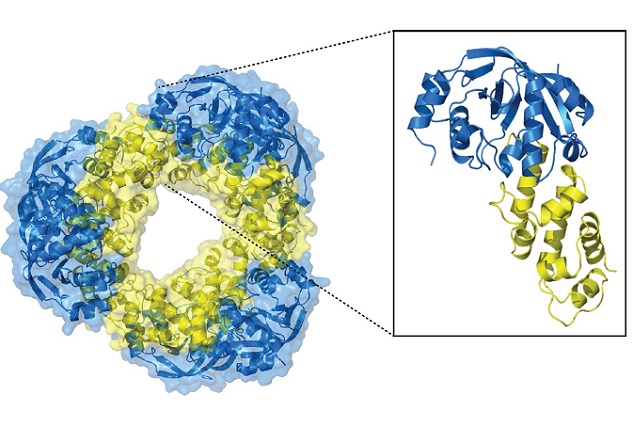
The high-resolution structure of the toxin-antitoxin system. CREDIT: EMBL Hamburg
The high-resolution structure – solved within eight months by first author Diana Freire – revealed a large and compact system with a double-doughnut shape. “It looks like a diamond, and it is very stable,” says EMBL group leader Matthias Wilmanns. The structure resembles the toxins of cholera and diphtheria: diseases that caused epidemics with hundreds of thousands of people dying even within the past 100 years.
Knowledge of the structure gave important guidance for further studying the system’s biochemistry – a challenging part of the project. By using an interdisciplinary approach, the team were able to discover the details of the TA system’s mode of action. When the toxin dissociates from its antidote, it becomes activated and starts to degrade essential cellular metabolites called NAD+ molecules. This “suicide” activity ultimately leads to the death of all bacterial cells. Why the bacteria have such a suicide system is puzzling, but there is no doubt it has the potential to be exploited as a drug target.
“Our collaborators in Toulouse were already able to extend the lifetime of mice infected with TB by activating the toxin in a controlled way,” says Parret. “If we find molecules that can disrupt the TA system – and thus trigger cell death – in TB patients, that would be the perfect drug.”
This project was a collaboration between researchers from the Wilmanns group at EMBL Hamburg and the Neyrolles group at the IPBS, CNRS/UniversitĆ© de Toulouse, and involved the Carvalho group at the Francis Crick Institute in London. The research team has started a partnership to work towards a potential TB drug, through EMBL’s technology transfer arm EMBLEM.
Source article:
Freire, D.M., Gutierrez, C., et al. An NAD+ phosphorylase toxin triggers Mycobacterium tuberculosis cell death. Molecular Cell, published online 18 February 2019.
Monday, 1 April 2019
New edition - Industrial Pharmaceutical Microbiology: Standards & Controls
A new edition of
“Industrial Pharmaceutical Microbiology: Standards & Controls”. The 5th
edition - fully revised and expanded - is edited by Dr. Tim Sandle. This publication covers the entire
spectrum of industrial and pharmaceutical microbiology, as applicable to those working in pharmaceuticals, medical devices, biotech, and healthcare, as well as academia.
The book is
available from the publisher - please see the Euromed website: http://euromedcommunications.com/index.php?option=com_virtuemart&view=productdetails&virtuemart_product_id=2&virtuemart_category_id=1&Itemid=201
The
reference is:
What readers are saying:
"This book is not simply about the science of microbiology for it takes the science into to the industrial setting and offers invaluable advice on how to apply it to the manufacture of pharmaceutical and healthcare products, and for keeping such products within microbial control. A further strength with the book is its topicality, in having the most recent regulations and standards featured. The book features 25 chapters covering environmental monitoring, water systems, vaccines, safety, biological indicators and microbiology laboratory management. Picking the stand-out chapters is difficult, because there are so many good ones. … In summary this book is essential for every pharmaceutical laboratory: scientific, topical and practical."
Posted by Dr. Tim Sandle, Pharmaceutical Microbiology
Monday, 25 March 2019
Biocontamination control for pharmaceuticals and healthcare
A
new book has been published – “Biocontamination Control for Pharmaceuticals and
Healthcare” by written Tim Sandle.
The
book outlines a biocontamination strategy that tracks bio-burden control and
reduction at each transition in classified areas of a facility. This key part
of controlling risk escalation can lead to the contamination of medicinal
products, hence necessary tracking precautions are essential. Regulatory
authorities have challenged pharmaceutical companies, healthcare providers, and
those in manufacturing practice to adopt a holistic approach to contamination
control. New technologies are needed to introduce barriers between personnel
and the environment, and to provide a rapid and more accurate assessment of
risk. This book offers guidance on building
a complete biocontamination strategy.
Key features of the book are:
Providing
the information necessary for a facility to build a complete biocontamination
strategy.
Helping
facilities understand the main biocontamination risks to medicinal products.
Assisting
the reader in navigating regulatory requirements.
Providing
insight into developing an environmental monitoring program.
Covering
the types of rapid microbiological monitoring methods now available, as well as
current legislation.
Table of Contents
1
Introduction
2.
Sources of microbial contamination and risk profiling
3.
GMP, regulations and standards
4.
Biocontamination control
5.
Introduction to cleanrooms and environmental monitoring
6.
Viable monitoring methods
7.
Selection of culture media
8.
Non-viable monitoring
9.
Rapid microbiological methods
10.
Designing an environmental monitoring programme
11.
Special Types of Environmental Monitoring
12.
Cleanrooms and microflora
13.
Assessment of pharmaceutical water systems
14.
Data handling and trend analysis
15.
Bioburden and endotoxin assessment of pharmaceutical processing
16.
Risk assessment and investigation for environmental monitoring
17.
Assessing and removing contamination risks from the process
18.
The human factor
19.
Biocontamination deviation management
374
pages
From
Academic Press at: https://www.elsevier.com/books/biocontamination-control-for-pharmaceuticals-and-healthcare/sandle/978-0-12-814911-9
From
Amazon at: https://www.amazon.com/Biocontamination-Control-Pharmaceuticals-Healthcare-Sandle/dp/0128149116
Reference:
Posted by Dr. Tim Sandle, Pharmaceutical Microbiology
Subscribe to:
Posts (Atom)